
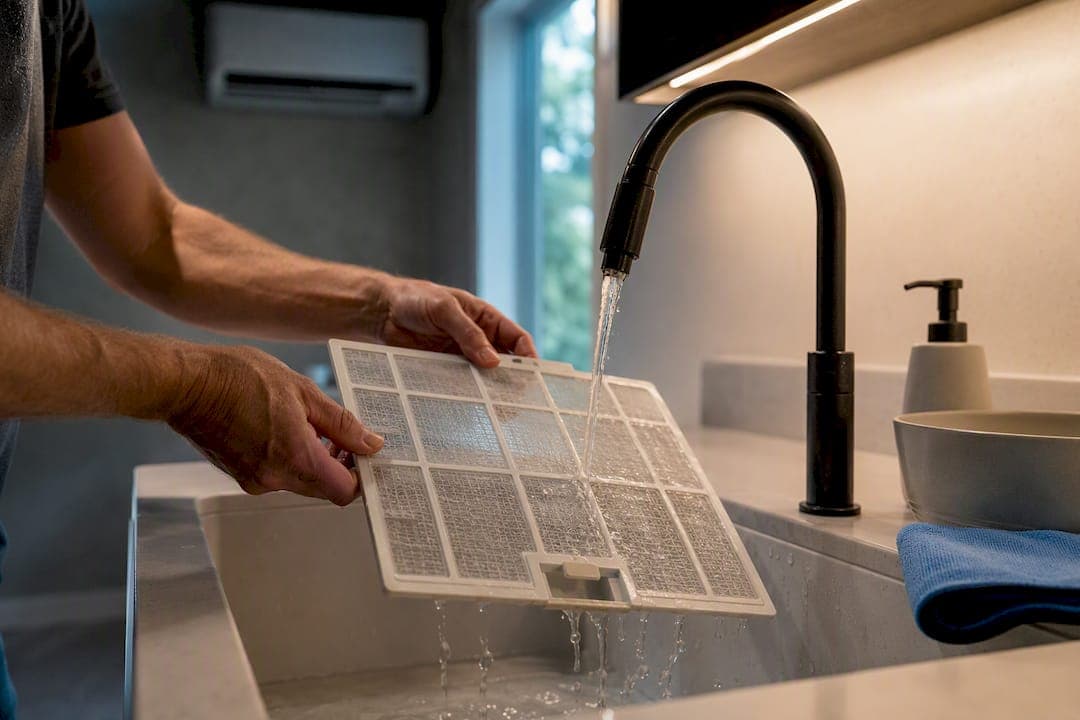
Rinse your mini split's filters every 2 to 4 weeks, inspect the condensate drain and indoor coil every 3 to 6 months, clear the outdoor unit each season, and book a professional service once a year, twice if the system runs heating and cooling year-round. Filter rinses are the one job that pays off the most: skip them and you lose airflow, drive up your power bill, and invite mould onto the coil. Everything else on this schedule exists to catch what a filter rinse can't.
TL;DR:
- Rinse filters every 2 to 4 weeks and monitor for increased greyness, especially if you have pets, smokers, or heavy dust, to prevent airflow issues.
- Conduct indoor unit housing wipes monthly and deep clean the coil every few months to maintain efficiency and avoid mold growth.
- Check and clear the condensate drain every 3 to 6 months, using vinegar or a wet-dry vacuum to prevent leaks and mold buildup.
- Arrange professional service once or twice a year for coil cleaning, refrigerant checks, and system safety inspections, especially if running heating and cooling year-round.
- Watch for signs like musty odors, ice formation, or rising power bills, indicating the need for immediate cleaning or technician intervention.
Table of Contents
- Mini split cleaning schedule at a glance
- What homeowners should clean, and how often
- How often to book professional mini split service
- Signs your mini split needs cleaning now, not on schedule
- A safe DIY routine, and where to draw the line
- What Clean Vents recommends for a realistic schedule
- Why the standard advice undersells filter maintenance
- Get your mini split professionally cleaned in Laval
- Sources
- FAQ
Mini split cleaning schedule at a glance
Print this table, stick it on the fridge, and you've got the whole routine in one place.
| Task | Frequency | Time needed | DIY? |
|---|---|---|---|
| Rinse reusable filters | Every 2–4 weeks | 10–15 min | Yes |
| Wipe indoor unit housing | Monthly | 5 min | Yes |
| Deep clean evaporator coil | Every few months | 30 minutes | Mostly yes, with care |
| Inspect and clear condensate drain | Every 3–6 months | 15–20 min | Yes |
| Clean outdoor condenser coil | Every 6 months (seasonal) | 20 minutes | Yes, with caution |
| Full professional service | 1–2 times per year | 45 minutes per head | No |
This lines up with the maintenance timetable most HVAC guides converge on, and it's roughly what manufacturers like Carrier build into their own service recommendations. Notice that only one row on that table is off-limits to a homeowner. The rest is well within reach on a weekend afternoon.
What homeowners should clean, and how often
Your part of the job breaks into four habits. Get these right and you'll rarely need anything more than the annual pro visit.
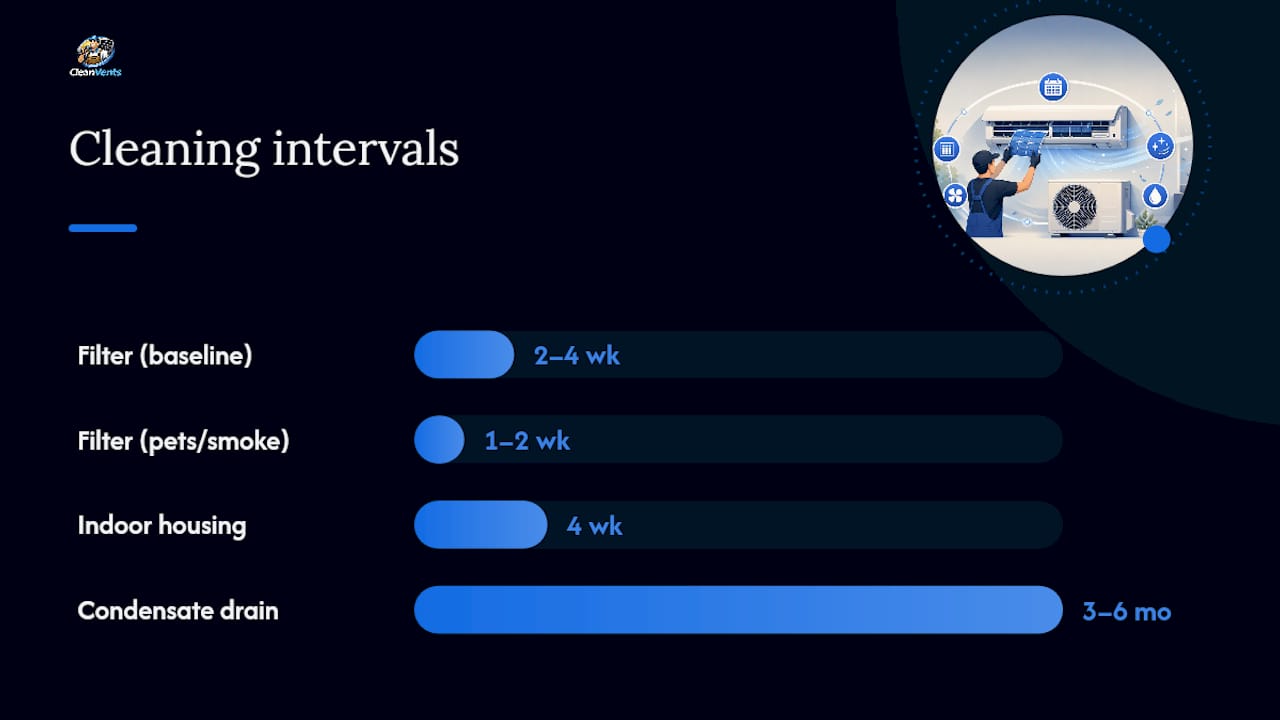
- Rinse the filters every 2 to 4 weeks. Slide them out, rinse under warm water, and let them air-dry completely before reinstalling. Bryant's own maintenance guidance points to that same 2 to 4 week window, and it's the baseline most manufacturers repeat because a dirty filter chokes airflow faster than almost anything else in the system.
- Wipe the indoor housing and grille monthly. A damp microfibre cloth handles the dust that settles on the casing. Don't pry off panels you're not sure how to reseat. If a cover feels stuck, stop and check your owner's manual instead of forcing it.
- Give the coil and blower a light clean every few months. A soft brush or a coil-safe spray on the visible fins is fine for routine upkeep. Save any deeper extraction of the blower wheel for a technician. Water and electrical components don't mix well, and a mini split's control board sits closer to the coil than most people expect.
- Check and clear the condensate drain every 3 to 6 months. Look for standing water or a musty smell near the indoor unit. A cup of diluted vinegar poured through the drain line, or a gentle pull with a wet/dry vacuum at the outdoor termination point, usually clears minor clogs before they turn into mould colonies or a leak onto your wall.
Homes with pets, smokers, or heavy dust load should tighten filter rinses to every 1 to 2 weeks. That single adjustment prevents most of the "why is my mini split blowing warm air" calls before they happen.
Pro Tip: Take a phone photo of your filter the day you install it clean. Compare it against the filter a month later. If it looks noticeably greyer, that's your personal cue to shorten the interval rather than sticking rigidly to the 4 week mark.
How often to book professional mini split service
A filter rinse handles dust. It does nothing for refrigerant pressure, biofilm inside the coil, or a blower wheel caked in grime you can't reach without disassembly. That's the gap a technician fills.
A proper professional visit typically covers:
- Chemical coil cleaning to strip biofilm and grease a homeowner spray can't touch
- Blower-wheel removal and cleaning
- Refrigerant pressure check
- Electrical connection and safety inspection
- Condensate drain-line chemical flush
- Airflow measurement to confirm the system is moving the air it's rated for
Book this at least once a year. If your mini split runs as a heat pump through winter and an air conditioner through summer, twice-yearly service catches refrigerant and electrical issues before they cause ice buildup or a failure during a shoulder-season cold snap. Expect the per-head cost and time to climb when there's heavy biofilm, cramped wall-mount access, or multiple indoor heads on one outdoor unit, since each of those adds labour a technician can't shortcut.
Signs your mini split needs cleaning now, not on schedule
Some symptoms mean don't wait for the next calendar reminder.
- Musty or mildew smell on startup usually points to mould growing on a wet coil or in a clogged drain pan.
- Sudden drop in cooling or heating power often traces back to a filthy filter or coil restricting airflow.
- Visible ice on the indoor or outdoor unit signals a refrigerant problem that needs a technician, not a rinse.
- A climbing power bill with no change in habits is a classic sign of restricted airflow forcing the compressor to work harder.
- Water pooling under or leaking from the indoor unit almost always means a blocked condensate drain.
That power-bill symptom isn't a coincidence. Dirty filters alone can push electricity use up an estimated 5 to 15 percent, and letting biofilm build unchecked on a coil compounds that loss month after month.
A safe DIY routine, and where to draw the line
Most of what keeps a mini split running well fits into three short tasks.
- Rinse the filter. Remove it, rinse with warm water only (no hot water, no bleach), shake off excess moisture, and let it dry fully before sliding it back in.
- Wipe the housing and clean the visible coil fins. Use a soft cloth or brush, and a non-corrosive coil cleaner if you're doing a deeper pass. Guides like This Old House recommend protecting nearby electrical components with plastic sheeting before spraying anything near the unit, and a mini-split cleaning kit with a catch bag makes this far less messy than improvising with a garden hose.
- Flush the condensate drain. Pour a diluted vinegar solution through the line, or use a wet/dry vacuum at the outdoor end to pull a clog free.
Stop there. Refrigerant handling, sealed-system repairs, electrical diagnostics, and full blower-wheel extraction all require a licenced technician, both for your safety and because opening a sealed refrigerant loop without certification is against the law in most Canadian jurisdictions. If your unit is dripping water despite a clear drain or not cooling properly after a filter rinse, that's your cue to call rather than dig deeper.
Pro Tip: Never reassemble a panel or filter while it's still damp. Trapped moisture behind a cover is exactly how mould gets a foothold you won't notice until the smell shows up weeks later.
The most common DIY mistakes: soaking the filter and skipping the air-dry step, spraying corrosive household cleaners instead of a coil-safe product, and reinstalling components before they're bone dry.
What Clean Vents recommends for a realistic schedule
A baseline that actually holds up: rinse filters every 2 to 4 weeks, check the coil and drain every 3 to 6 months, and bring in a certified technician at least once a year, twice if your system carries the full heating and cooling load. That's the rhythm INCV-certified technicians typically follow for wall-AC and mini split units in residential service areas.
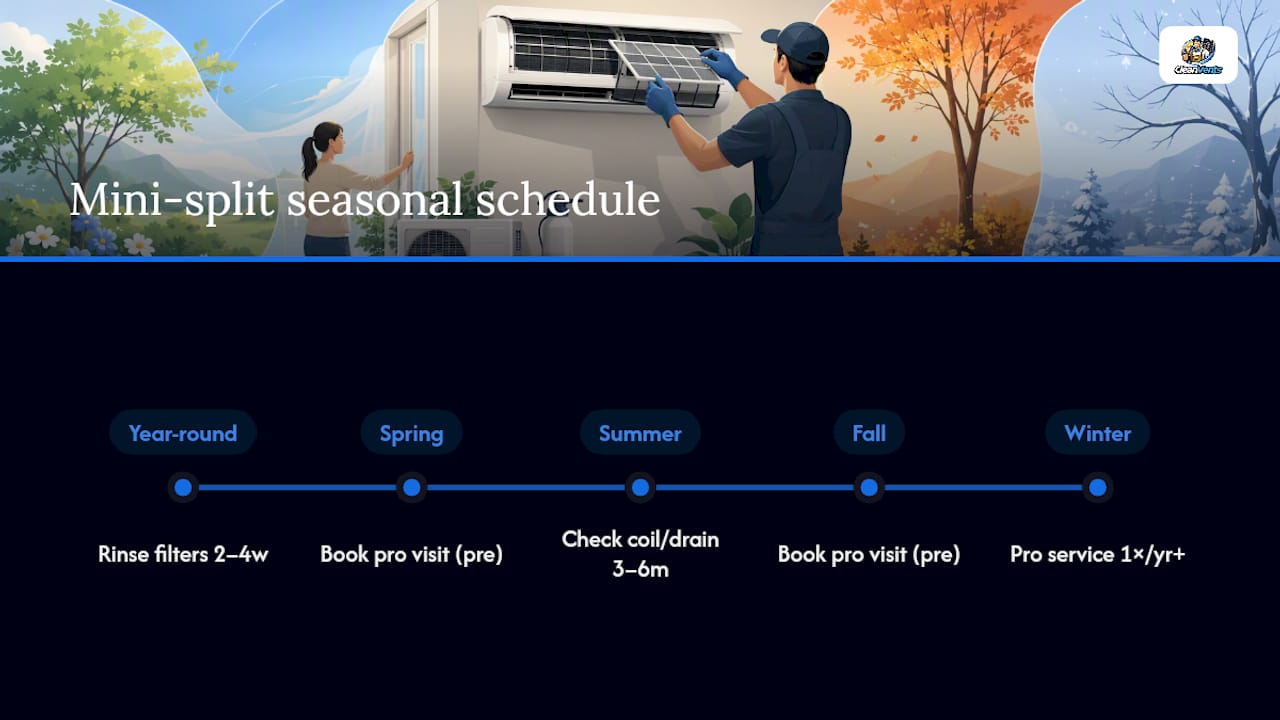
The practical trick is timing. Book your professional visit a couple of weeks before the cooling season ramps up in spring, or before heating season starts in fall, rather than waiting until the system is already struggling. For homes running multiple indoor heads, budget the service per head rather than assuming one flat rate covers the whole system. Our blog covers troubleshooting steps for the specific symptoms that mean "call now" instead of "wait for the schedule."
Why the standard advice undersells filter maintenance
Most maintenance guides treat filter rinses, coil checks, and pro service as three equally weighted line items on a checklist. They aren't equal. A filter rinse takes ten minutes and prevents a large share of the airflow and efficiency problems that eventually turn into a service call. Skip it for two months and you're not just losing a little efficiency, you're loading dust onto a coil that then needs a chemical clean instead of a wipe.
The conventional wisdom also underplays how much frequency should shift with your actual household. A condo with no pets and light use can stretch filter rinses toward the 4 week mark. A house with two dogs and a wood stove kicking dust into the air needs that same task every 10 days, and pretending otherwise just delays the coil-mould problem, not prevents it.
If you take one thing from this: treat the filter rinse as non-negotiable and let everything else, including how urgently you book a technician, respond to what that filter tells you.
— Clean Vents
Get your mini split professionally cleaned in Laval
Professional services exist for homeowners who prefer to book a certified cleaning instead of DIY maintenance. Technicians can handle wall-mounted AC and mini split cleaning; coil and blower service; drain-line flushes; and full system inspections, often with upfront pricing.
Many jobs come with INCV-certified technicians and satisfaction guarantees, helping customers know costs upfront and ensuring work quality checks before completion. If your unit is heading into a heating or cooling shoulder season, book two to three weeks ahead, since that's when demand for HVAC tune-ups spikes and backlogs build fast. Get a free online quote for wall AC cleaning or call to lock in a time before the next season fills our schedule.
Sources
- Ductless Mini Split Maintenance
- How to clean and maintain your mini-split
- Mini split maintenance guide — practical effects of neglect
FAQ
Can I clean my mini split myself?
Yes, for filter rinses, surface wiping, light coil brushing, and condensate drain flushing. Refrigerant work, electrical repairs, and full blower-wheel extraction need a certified technician.
What is the average cost to clean a mini split?
Pricing varies by number of indoor heads and how much biofilm or debris has built up, with tighter wall-mount access typically raising the cost. Ask for a flat-rate quote before booking so you know the price upfront.
What's the average lifespan of a mini split?
A well-maintained mini split commonly runs 15 to 20 years, though skipping filter and coil care shortens that by forcing the compressor to work harder for longer.
Is it okay to leave my mini split AC on all the time?
Running it continuously is fine for the equipment and often more efficient than repeated on/off cycles, provided you're keeping filters clean on schedule. A dirty filter under constant use accelerates the 5 to 15 percent efficiency loss tied to restricted airflow.