
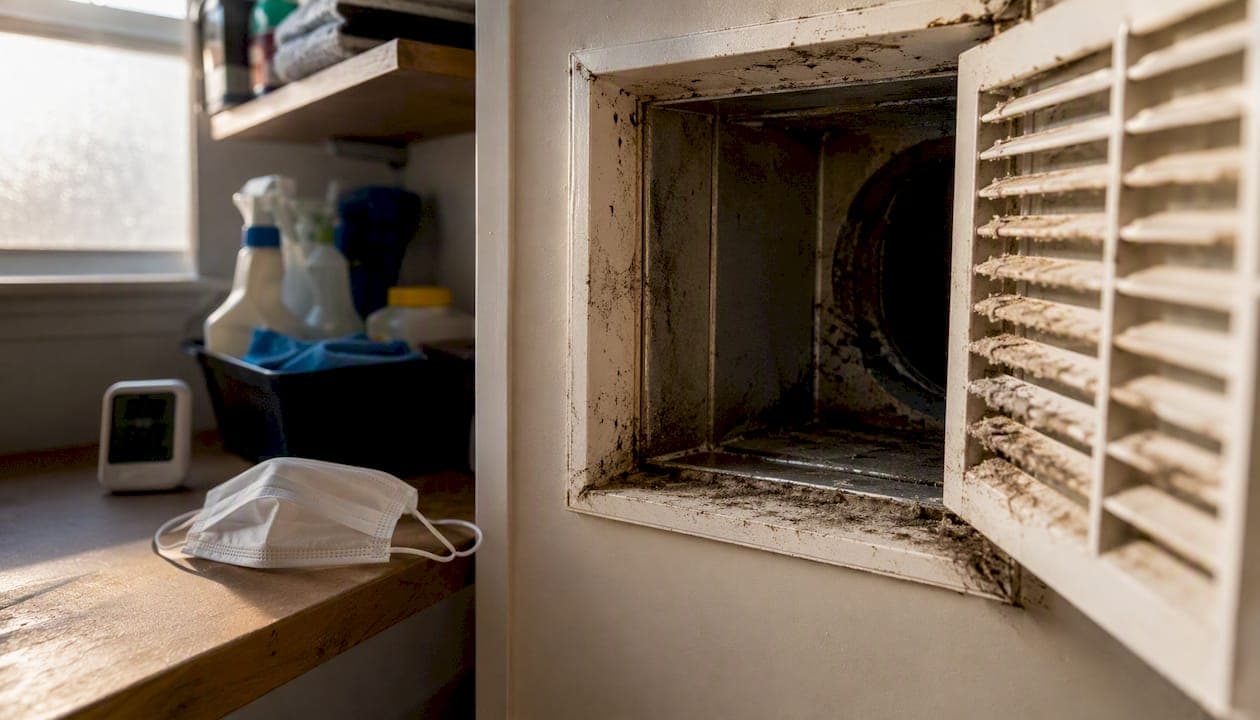
That stale, earthy odour hitting you when the HVAC kicks on is almost always the same thing: moisture trapped somewhere inside the system, feeding microbial growth. It is not a cosmetic problem, and it will not clear up on its own.
Do these three things right now:
- Switch your HVAC fan to ON (not AUTO) and walk through the house. If the smell comes from every register, the source is likely the air handler or ducts. If it is isolated to one room, start there.
- Pull and inspect the filter. A wet, grey, or visibly dirty filter is a direct contributor. Replace it immediately.
- Check the indoor unit's drain pan (the shallow tray beneath the evaporator coil). Standing water or a slimy residue there confirms a drainage problem.
If the smell persists after these checks, or if you spot visible dark growth at any register or inside the unit, stop and call a certified HVAC or duct-cleaning technician. Continuing to run the system circulates whatever is growing in there through every room.
Key takeaways
A musty smell from vents signals trapped moisture and microbial growth inside the HVAC system, and source removal combined with humidity control is the only fix that lasts.
| Point | Details |
|---|---|
| Start with three checks | Inspect the filter, drain pan, and run the fan on ON to locate the odour source. |
| Humidity is the root cause | Keep indoor relative humidity between 30% and 50% to prevent microbial growth from re-establishing. |
| Masking does not work | Fragrance sprays and particulate filters do not remove gaseous odour compounds adsorbed to duct surfaces. |
| Call a pro when DIY stalls | Persistent smell after filter and drain checks, visible mould, or occupant health symptoms all warrant a certified technician. |
| Clean Vents for Laval homes | INCV-certified inspection and cleaning covering coil, blower, drain, and ducts, with flat-rate pricing and a satisfaction guarantee. |
Table of Contents
- Why does air from vents smell musty? Common causes explained
- Step-by-step checks and safe DIY fixes to try first
- How to tell if the smell means mould and what health signals matter
- When should you stop DIY and call a professional?
- How to prevent musty smells from coming back
- Why masking the smell or using basic filters often fails
- How Clean Vents resolves musty vent odours for Laval homeowners
- Clean Vents: book an inspection for musty vent odours in Laval
- Sources
- FAQ
Why does air from vents smell musty? Common causes explained
A musty odour from your HVAC almost always traces back to moisture meeting organic material — dust, debris, or the surfaces of HVAC components themselves. The smell is produced by microbial volatile organic compounds (MVOCs), the metabolic byproducts of mould, mildew, and bacteria. Here are the usual suspects:
- Clogged or overflowing condensate drain. The evaporator coil pulls humidity from the air and drips it into a drain pan. When the drain line clogs, water pools, and microbial growth follows within days.
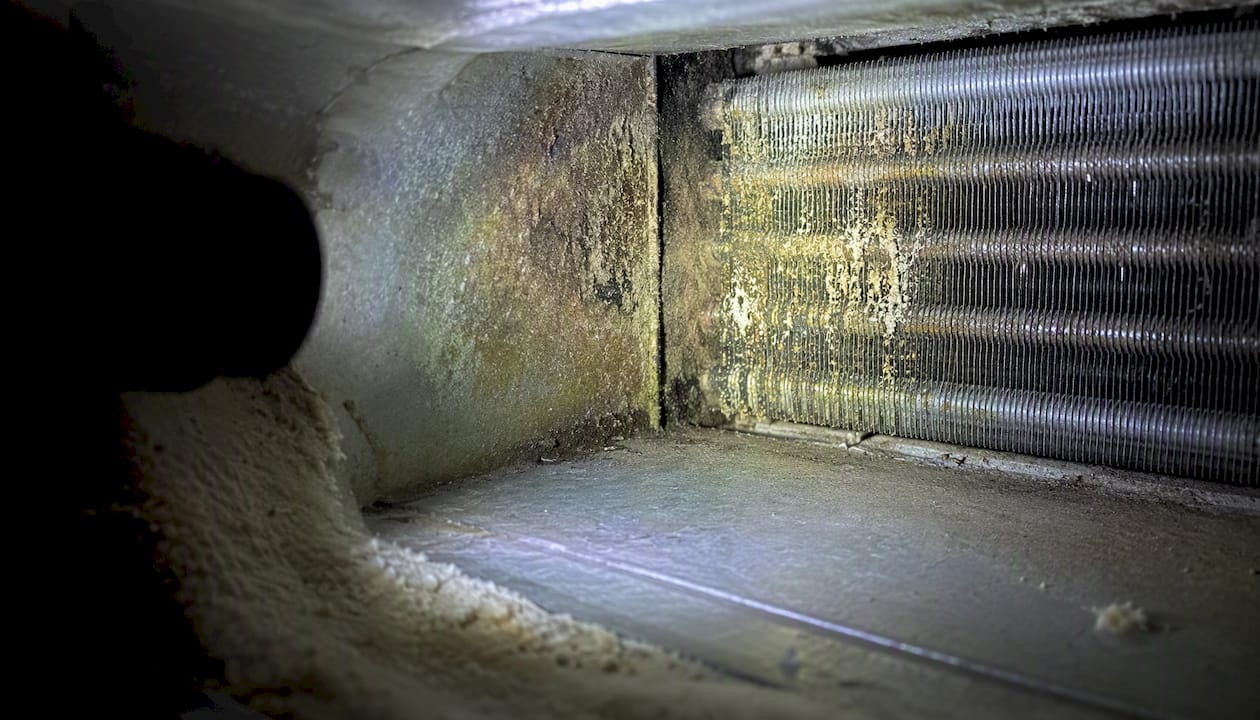
- Wet or dirty evaporator coil. Dust sticks to the damp coil surface and becomes a growth medium. This is one of the most common sources of a persistent musty smell from HVAC systems.
- Duct dust and settled debris. Ducts accumulate dust, skin cells, and fibres over years. In humid conditions, that layer supports microbial growth. Learn more about how duct debris affects airflow and air quality.
- Leaky ducts drawing in attic or basement air. Gaps in ductwork pull in unconditioned, often humid air from spaces that may already have moisture or mould issues.
- High indoor humidity. Basements, crawlspaces, and poorly ventilated bathrooms raise whole-home humidity. When relative humidity stays above 50%, HVAC components stay damp long enough for growth to establish.
- Contaminated wall-mounted AC or ductless mini-split. The blower wheel and filter on these units trap dust and moisture. Without regular cleaning, they become a concentrated odour source.
| Cause | Typical smell character | How common |
|---|---|---|
| Clogged condensate drain/pan | Strong, stagnant, earthy | Very common |
| Dirty or wet evaporator coil | Musty, slightly sweet | Very common |
| Duct dust and debris | Stale, dusty-musty | Common |
| Leaky ducts (attic/basement air) | Musty, sometimes mouldy | Moderately common |
| High indoor humidity | Diffuse, whole-home mustiness | Common in humid climates |
| Wall AC / mini-split contamination | Sharp, concentrated musty | Common in units not cleaned annually |
Step-by-step checks and safe DIY fixes to try first
Work through these in order. Trane's residential troubleshooting guidance identifies filter condition, blocked registers, and the condensate drain as the primary starting points — and that sequence holds for most Canadian homes.
-
Pinpoint whether the smell is whole-house or localised. Run the fan on ON mode for five minutes with all registers open. Walk each room. A whole-house smell points to the air handler or main ducts; a single-room smell narrows it to that branch or register.
-
Replace the filter. If the filter is wet, that alone tells you there is a drainage or humidity problem upstream. Note the filter's MERV rating — a filter that is too restrictive for your system can reduce airflow and keep the coil wetter than it should be.
-
Inspect the condensate drain pan. The pan sits directly beneath the evaporator coil. If it holds standing water, the drain line is partially or fully blocked. A clear, properly draining pan should be nearly dry between cycles.
-
Clear the condensate line. Turn off power to the unit at the breaker first. Locate the drain line access port (usually a capped T-fitting near the air handler) and use a wet/dry vacuum to pull the blockage from the outdoor end of the line. Alternatively, slowly pour a cup of distilled white vinegar into the access port and let it sit for 30 minutes before flushing with water.
-
Visually check registers and accessible duct openings. Remove a few register covers and shine a flashlight into the duct. Dust is normal; black or green growth on the duct walls or register itself is not.
-
Run a portable dehumidifier if your indoor humidity reads above 50% on a hygrometer. Drop it to the 40–50% range and re-run the HVAC after 24 hours to see whether the odour has reduced.
Safety notes before you start: Power down the air handler at the breaker before touching any internal component. Do not spray bleach or disinfectant inside ducts — residues get distributed through the system and can irritate airways. And do not spray fragrance products into vents; they mask the smell without touching the source and can coat internal components.
Pro Tip: Before calling a technician, photograph the drain pan, the filter, and any visible growth at registers. A good technician will ask what you observed, and photos save time during diagnosis.

How to tell if the smell means mould and what health signals matter
Not every musty smell is mould, but some are. The distinction matters because mould in an HVAC system gets distributed to every room the system serves.
Direct indicators that mould is likely present in the system:
- The musty odour appears every time the system runs, not just after a long shutdown.
- You can see black, green, or grey growth at registers, on the drain pan, or on accessible coil surfaces.
- Duct insulation or the air handler cabinet shows water staining or feels damp to the touch.
- The smell returns within days or weeks after you clean accessible components.
On the health side, the signals worth taking seriously include worsening allergy symptoms that improve when you leave the house, chronic nasal or throat irritation in multiple occupants, and unexplained headaches that correlate with the HVAC running. Children, elderly residents, and anyone immunocompromised are more sensitive to elevated MVOC and mould spore levels and should be given extra weight in your decision to act.
Decision threshold: If you have visible growth inside the system, persistent odour after completing the DIY checks above, or occupants reporting health symptoms, book a professional inspection rather than continuing to troubleshoot. A qualified technician can access components a homeowner cannot safely reach, and some mould situations require a certified remediator rather than just a cleaning service. Understanding why black mould keeps returning in a building often comes down to an unresolved moisture source — the same principle applies inside ductwork.
When should you stop DIY and call a professional?
Call a certified HVAC or duct-cleaning technician when:
- The smell persists after replacing the filter and clearing the condensate drain.
- You see visible mould growth inside the unit, at registers, or on duct surfaces.
- The odour returns within a few weeks of cleaning.
- There is active water leaking at or around the air handler.
- Multiple occupants report respiratory symptoms or worsening allergies.
A qualified technician will typically work through the following during a service visit:
- Full visual inspection of the air handler, evaporator coil, blower compartment, and accessible ductwork.
- Evaporator coil cleaning using appropriate coil cleaner (not bleach).
- Condensate pan and drain line clearing and treatment.
- Blower wheel cleaning, which is a common odour source that homeowners rarely access.
- Targeted duct cleaning where contamination is confirmed, or a full system clean when debris is widespread.
- Referral to a mould remediator if contaminated insulation or structural materials are found.
Choosing a NADCA-certified professional (or an INCV-certified technician in Quebec) means the contractor follows industry-standard inspection and cleaning protocols. Ask for documentation of what was cleaned and request before-and-after photos.
Ballpark Canadian cost ranges (qualitative):
| Service type | Typical scope | Relative cost | Time to fix |
|---|---|---|---|
| Diagnostic visit | Inspection, identify source | Low | 1–2 hours |
| Minor repair/clean | Drain clear, coil clean, filter | Low to moderate | 1–3 hours |
| Full duct cleaning | Whole-system duct and component clean | Moderate | 3–6 hours |
| Mould remediation | Contaminated materials removed/treated | Higher | 1–3 days |

How to prevent musty smells from coming back
Fixing the source is step one. Keeping it from returning is a different discipline, and it mostly comes down to moisture control and a consistent maintenance schedule.
Maintenance schedule:
- Change the filter regularly. Basic fibreglass filters require frequent replacement; higher-quality filters like MERV-11 or MERV-13 can last longer depending on household conditions such as presence of pets or occupancy level.
- Schedule a professional HVAC tune-up twice a year, ideally before cooling season and before heating season. The technician will check refrigerant charge, clean the coil, and verify condensate drainage.
- Have ductwork inspected annually if you live in a humid climate, have had any water events (flooding, roof leak, burst pipe), or notice recurring odours.
Humidity targets:
A whole-house dehumidifier integrated with the HVAC is the most effective solution for persistently humid homes; portable units work for problem rooms or basements.
Practical prevention steps:
- Keep attic, basement, and crawlspace areas dry. Sub-floor moisture is a major driver of whole-home humidity and sub-floor ventilation is one of the most overlooked prevention measures.
- Seal duct leaks with mastic sealant or foil tape. Leaky ducts in unconditioned spaces pull in humid, potentially contaminated air on every cycle.
- Verify the condensate line has a proper trap and is pitched toward the drain. A flat or back-pitched line holds water and clogs repeatedly.
- Avoid drying clothes indoors in poorly ventilated rooms — it raises humidity significantly and quickly.
Pro Tip: *A $20 digital hygrometer placed near the air handler return tells you more about your system's moisture risk than almost any other single measurement.
Why masking the smell or using basic filters often fails
Spraying an air freshener into a vent feels like doing something. It is not. The odour compounds produced by microbial growth — MVOCs and other volatile organics — are adsorbed onto duct surfaces, insulation, and coil fins. They re-emit continuously. A fragrance spray dilutes the perceived smell for an hour and then the source keeps releasing. Expert guidance is consistent on this point: masking products do not address moisture or microbial growth, and spraying chemicals into the air stream can coat components and introduce additional irritants.
Standard particulate filters — even high-MERV options — have the same limitation for odour. They capture particles (dust, spores, pollen) but do not remove gaseous contaminants. ASHRAE's guidance on gas-phase air-cleaning systems is direct: odorous and toxic gaseous contaminants require molecular filtration beyond what particulate filters provide. An MDPI review of indoor odour pollution reinforces this, showing that ventilation dilution alone often fails when contaminants are adsorbed to materials or are low-volatility compounds.
What actually helps:
- Source removal. Clean or replace contaminated components. Nothing else works without this step.
- Gas-phase or activated carbon filtration. Appropriate for homes with persistent VOC or odour issues after source removal.
- UV-C irradiation near the coil. UV-C systems installed in ventilation units can reduce biofilm formation on damp coil surfaces, lowering the rate at which odour-producing growth re-establishes after cleaning.
- Humidity control. Removing the moisture that sustains microbial growth is the only durable fix.
How Clean Vents resolves musty vent odours for Laval homeowners
Clean Vents is an INCV-certified duct and vent cleaning specialist serving Laval and surrounding communities including Rosemère, Boisbriand, Blainville, Lorraine, Bois-des-Filion, and Sainte-Thérèse. The process for a musty-odour call follows a clear sequence:
- Inspection and diagnosis. The technician identifies the odour source before any cleaning begins — coil condition, drain pan status, blower compartment, and duct interior.
- Targeted cleaning. Depending on findings: evaporator coil cleaning, blower wheel cleaning, condensate pan and drain servicing, register and duct cleaning.
- Wall-mounted AC and mini-split cleaning where applicable, since these units are a concentrated odour source when neglected.
- Moisture control advice. After cleaning, the technician advises on humidity targets, drainage maintenance, and filter schedule specific to the home.
- Remediation referral. If contaminated insulation or structural materials are found, Clean Vents refers to a certified remediator rather than attempting work outside the scope of duct cleaning.
Trust signals worth confirming when booking any duct-cleaning service:
- INCV or NADCA certification of the technician.
- Flat-rate, upfront pricing with no surprise add-ons.
- Before-and-after documentation of the cleaning. Real before-and-after results show what a thorough clean actually looks like.
- A satisfaction guarantee.
Pro Tip: When you call to book, ask specifically: "Will you clean the blower wheel and condensate pan, or only the ducts?" A quote that covers only duct runs and skips the air handler components often misses the actual odour source.
A note from the Clean Vents team
Musty air from vents is a moisture warning, not a minor inconvenience. Every week that passes with a wet drain pan or a contaminated coil is another week of spores and MVOCs circulating through your home. The fix is almost always straightforward once the source is identified: inspect, remove the source, verify the drainage is working, and control humidity going forward. That is the sequence we follow on every call, and it is the only approach that produces a lasting result rather than a temporary improvement.
Clean Vents: book an inspection for musty vent odours in Laval
Persistent musty air from vents means something inside the system needs attention, and a filter change alone rarely solves it. Clean Vents provides flat-rate air duct cleaning and inspection for homeowners in Laval and surrounding communities, with INCV-certified technicians who inspect the full system — coil, blower, drain, and ducts — before cleaning anything.

The outcome of a typical service visit is either a confirmed clean system with documented results, or a clear referral if remediation is needed. No guesswork, no upselling mid-job. Get a free quote at Cleanvents or call to book an inspection for your home.
Sources
- AC smells musty - Trane residential troubleshooting
- How to fix a musty-smelling air conditioner
- Indoor Odour Pollution: An Interdisciplinary Review from Sources to Control and an Intelligent Building Environment Management Framework
- Why choose a NADCA member?
FAQ
How do you get rid of a musty smell coming from air vents?
Start by replacing the filter, clearing the condensate drain line, and cleaning the drain pan. If the smell persists after those steps, the evaporator coil or duct interior likely needs professional cleaning.
Does a musty smell from vents automatically mean there is mould?
Not always — stale dust and a clogged drain can produce a similar odour without active mould growth. Visible dark growth, a smell that returns immediately after cleaning, or occupant health symptoms are the clearest indicators that mould is present.
What does mould in vents actually smell like?
Mould in HVAC systems typically produces a persistent earthy, damp, or musty odour that intensifies when the system runs and may carry a faintly sweet or sour note depending on the species involved.
Will a musty AC smell go away on its own?
No. The moisture source that feeds microbial growth does not resolve without intervention. Running the system without fixing the drain or cleaning the coil typically makes the odour worse over time, not better.