
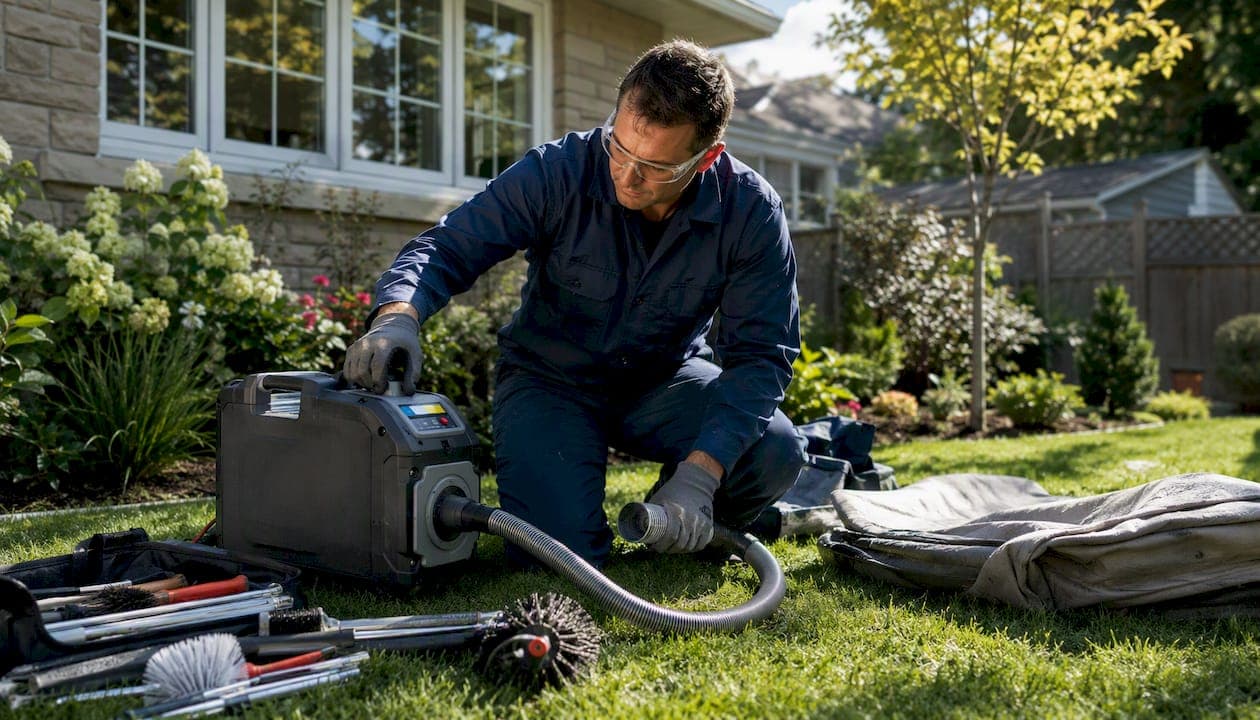
When you hire a professional to clean your ducts, the single outcome to insist on is source removal to a verifiable, visibly clean standard — meaning all non-adhered contaminants are mechanically dislodged and captured by a HEPA-filtered negative-air vacuum, not blown around or masked with a spray. That is the standard, and anything short of it is not a complete job.
Before you call a contractor, know the three equipment categories a legitimate service must use:
- Inspection camera or borescope — to document duct condition before and after work
- Negative-air vacuum system with HEPA filtration — truck-mounted or portable, depending on site access
- Mechanical agitation tools — motorized brushes, air whips, or skipper balls to dislodge debris the vacuum alone cannot reach
Canada has no single federal regulator for duct cleaning. That gap makes certification frameworks like CAST™ — anchored to the CNADCA IAQ-100-2025 standard — the most reliable proxy for consistent, ethical service. Ask every contractor you call whether their technicians hold CAST™ or CNADCA membership before you book.
Pro Tip: Write these three categories on a sticky note before you phone a contractor. If they cannot name the specific vacuum system and agitation method they plan to use, hang up.
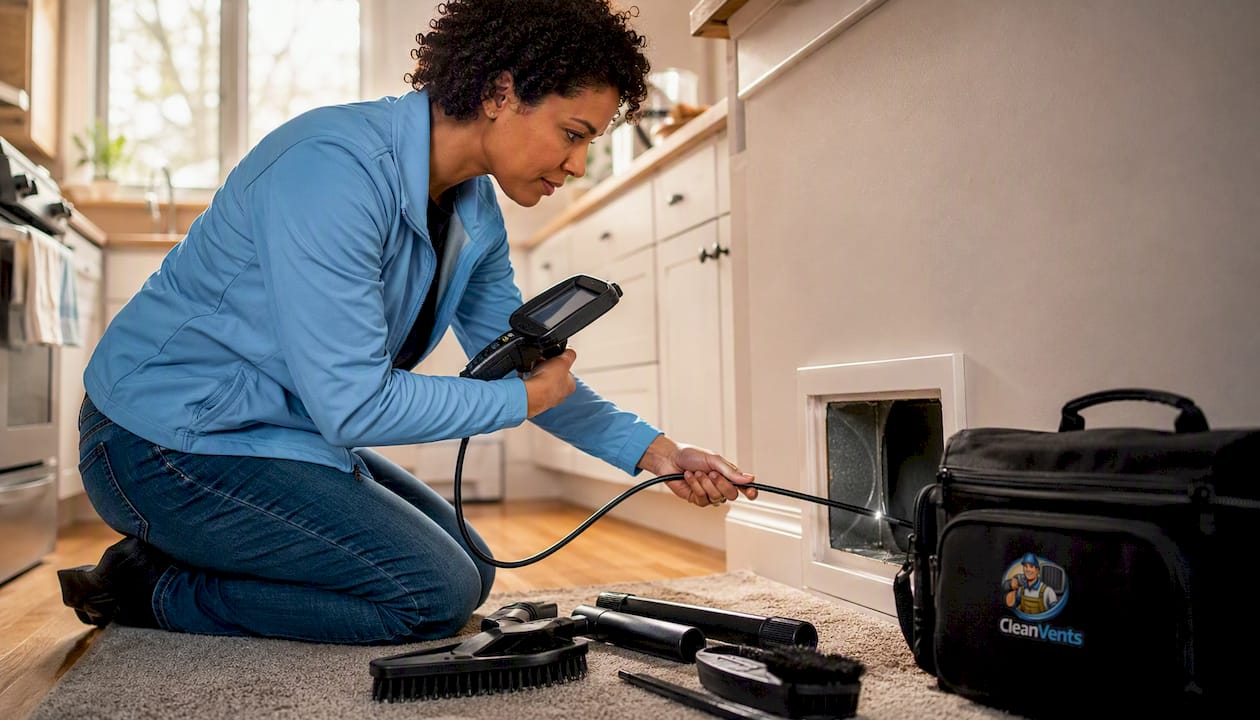
Table of Contents
- What inspection tools do professionals use before and after cleaning?
- How do professionals actually remove deep debris from your ducts?
- How do pros protect your home during the cleaning process?
- What should a complete duct cleaning service actually deliver?
- How do you choose a trustworthy duct cleaning contractor in Laval?
- How long does duct cleaning take, and what drives the cost?
- What scams and poor practices should you watch out for?
- Key takeaways
- A local perspective on equipment and verification
- Clean Vents: professional duct cleaning for Laval homeowners
- Useful sources and further reading
What inspection tools do professionals use before and after cleaning?
Inspection cameras, periscopes, and borescopes are how a professional confirms what is actually inside your ducts — not what they assume is there. A camera inserted at the main trunk, branch runs, air handling unit, blower compartment, and registers gives an objective baseline before work starts. The same pass after cleaning is the only way to prove the job is done.
Commercial duct inspection cameras capture footage that can be shared with you directly — on a screen during the visit or as a video file afterward. If a contractor cannot show you before-and-after footage, you have no way to verify the work was completed to standard.
"Will you do a camera inspection and share before-and-after photos or video?" is the single most important question to ask on the phone. An acceptable answer names the camera model or system they use and confirms you will receive the footage. A vague "we check everything visually" is not acceptable.
The components that must be inspected include the main supply and return trunk lines, all branch ducts, the air handling unit, the blower wheel, individual registers, and evaporator coils if accessible. Skipping any of these leaves a potential contamination source undocumented.
Pro Tip: Ask the contractor to send you a sample inspection report from a previous job (with client details removed). A professional who documents work routinely will have one ready.
How do professionals actually remove deep debris from your ducts?
Source removal is the method: mechanical agitation paired with continuous vacuum collection. Blowing or air-only methods simply redistribute dust instead of removing it, which is why the combination of agitation and suction is the accepted approach under CNADCA and NADCA guidance.
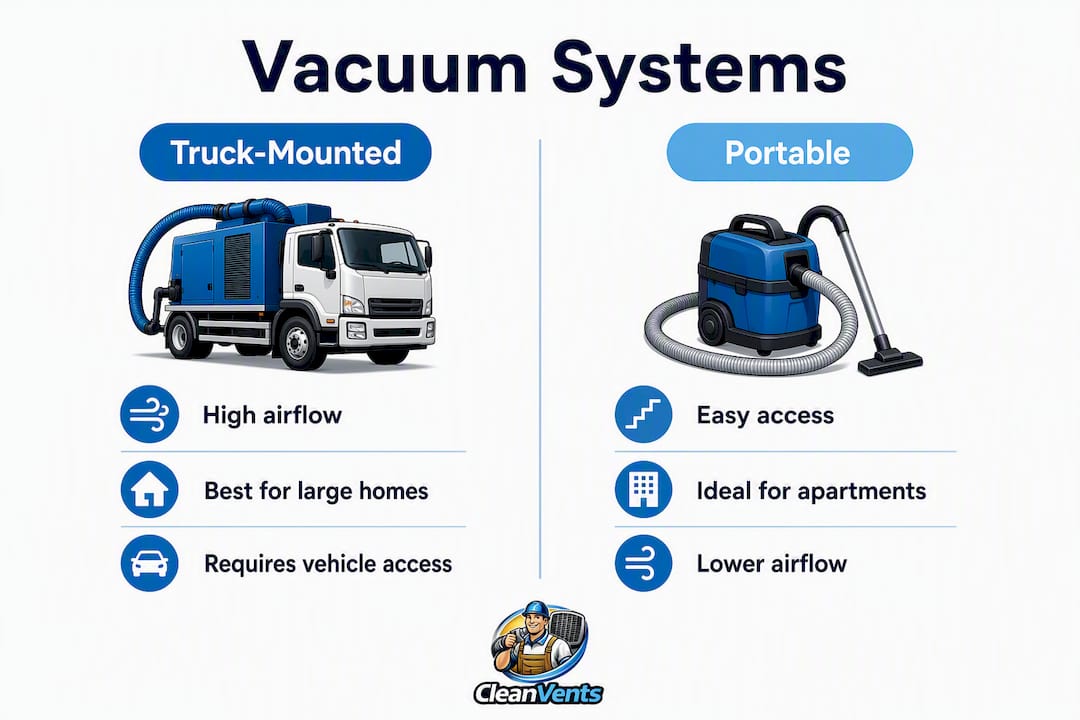
Vacuum systems: truck-mounted vs. portable
| System type | Best for | Key advantage | Limitation |
|---|---|---|---|
| Truck-mounted negative-air | Single-family homes with driveway access | High sustained airflow (CFM); no exhaust indoors | Cannot reach high-rise condos or stair-only buildings |
| Portable HEPA-filtered vacuum | Condos, apartments, stair access | Flexible placement; HEPA exhaust indoors | Lower sustained CFM than truck-mounted |
| Robotic/remote agitation (e.g., ANATROLLER ARI 100) | Complex or large commercial systems | Reaches inaccessible configurations | Slower; typically paired with a separate vacuum |
Truck-mounted systems deliver higher sustained airflow and are the preferred choice when a vehicle can park close to the building. Portable HEPA-filtered units are the correct answer for Laval condos and multi-unit buildings where truck access is limited or impossible — they exhaust filtered air indoors and must meet a filtration efficiency of 99.97% at 0.3 microns to prevent re-contamination.
Agitation tools
Motorized rotary brushes scrub duct walls as the vacuum pulls debris away. Air whips and scorpion systems use compressed air to flail against duct surfaces, dislodging material that brushes miss. Forward and reverse skipper balls create turbulent airflow that lifts settled dust from flat duct floors. A professional crew uses at least one of these in combination with the vacuum — never as a standalone step.
Source removal combining mechanical agitation with high-powered vacuuming is the only reliable way to reach stubborn contaminants deep in complex ductwork. Equipment that only blows air moves the problem rather than solving it.
How do pros protect your home during the cleaning process?
Containment is not optional — it is an engineering requirement. CNADCA technical guidance specifies negative pressure monitoring, HEPA vacuum servicing, and defined containment levels as procedural requirements, not suggestions.
Here is what a properly run job looks like from a containment standpoint:
- Negative pressure differential is established and maintained throughout cleaning so that any dislodged debris is drawn toward the vacuum, not into your living space.
- Registers and grilles are temporarily sealed at each zone not being actively cleaned, preventing cross-contamination between sections.
- Truck or generator placement keeps combustion exhaust away from any building air intake — a detail that matters more in attached garages and tight driveways common in Laval neighbourhoods.
- Ambient HEPA air scrubbers may be deployed in the work area during and after cleaning to capture any airborne particulate that escapes the primary vacuum.
- Waste containment and removal should be documented: ask the contractor how collected debris leaves the site and whether it is bagged before transport.
"How will you contain and remove waste, and will you use HEPA air scrubbers during the job?" is the containment question to ask on the phone. A contractor who cannot answer it specifically has not thought through the job.
NADCA guidance reinforces that cleaning specifications must be tailored to each building, with site evaluation and engineering controls confirmed before work begins — not improvised on arrival.
What should a complete duct cleaning service actually deliver?
A finished job is not just a cleaner system — it is a documented one. Here is what you should receive:
- Written scope of work agreed before the job starts, listing every component to be cleaned
- Before-and-after photos or video from the inspection camera, covering trunk lines, branches, and the air handling unit
- Signed work report confirming what was cleaned, what equipment was used, and any findings (debris type, mould suspicion, damaged components)
- Negative pressure verification — documented confirmation that the system was under negative pressure during cleaning
- Waste-handling statement describing how collected material was contained and removed
- Final walkthrough with the technician so you can ask questions before they leave
"Verifiable cleanliness" under NADCA and CNADCA protocols means a visual inspection confirms no visible debris remains on accessible duct surfaces — not a technician's verbal assurance, but camera-documented proof.
Pro Tip: Keep your signed work report with your home maintenance records. If you sell the property or make an insurance claim, documented HVAC maintenance history has real value.
How do you choose a trustworthy duct cleaning contractor in Laval?
Questions to ask on the first call
- Do your technicians hold CAST™ certification or CNADCA membership?
- What vacuum system do you use — truck-mounted or portable HEPA-filtered?
- Will you perform a camera inspection and provide before-and-after footage?
- How do you establish and verify negative pressure during cleaning?
- What agitation tools do you use alongside the vacuum?
- Do you carry liability insurance and WSIB/CNESST coverage?
- Can you provide a written estimate before the job starts?
Trust signals to look for
- INCV or CAST™ credentials displayed on the website or invoice
- Clear, itemised pricing with no vague "starting from" language
- Willingness to share sample inspection reports or footage
- Experience with Laval residential properties, including multi-unit buildings
- A written satisfaction guarantee
Red flags to avoid
- Offers of spray-only or "sanitising fog" cleaning with no mechanical agitation
- Refusal or inability to perform camera verification
- A very low flat fee quoted without any site assessment
- Pressure to add chemical biocides or coatings — Canada has no federally approved chemical biocides for routine use inside residential ducts, and physical cleaning remains the recommended approach
- Vague descriptions of equipment ("we use professional vacuums")
How long does duct cleaning take, and what drives the cost?
| Property type | Typical time on site | Main variables that add time |
|---|---|---|
| Single-family home (1–2 zones) | 2–4 hours | Long trunk runs, coil cleaning, heavy debris |
| Townhouse or semi-detached properties | Typically need a longer cleaning time due to multiple floors or transport challenges. | Multiple floors, stair transport of equipment |
| Condo or apartment units | Usually require less time on site, reflecting access and equipment setup factors. | Access restrictions, portable equipment setup |
Time on site covers site assessment, equipment setup, cleaning, camera verification, and clean-up. Coil cleaning, if included, adds 30–60 minutes and requires the system to be powered down safely.
Cost drivers a contractor should explain to you:
- System size and number of supply/return vents — more vents mean more time
- Accessibility — truck access reduces setup time; stair-only buildings require portable equipment and longer setup
- Debris level — a system that has never been cleaned takes longer than routine maintenance
- Mould suspicion — if the camera reveals suspected mould, additional containment and testing protocols apply
- Coil and register cleaning — these are often priced separately; confirm what is included upfront
A reputable contractor will not quote a firm price without knowing your system size and access conditions. A flat fee quoted blind over the phone, without those details, is a warning sign.
What scams and poor practices should you watch out for?
Some offers that look like duct cleaning are not. Knowing the difference protects your system and your wallet.
- Spray-only "cleaning" involves applying a chemical fog or sanitiser without any mechanical agitation or vacuuming. It does not remove debris — it coats it. Ask specifically whether a vacuum and agitation tools will be used.
- Allergy or mould cure claims — no duct cleaning service can guarantee to eliminate allergy symptoms or remediate confirmed mould without separate testing and remediation protocols. Promises to the contrary are marketing, not fact.
- Refusal to show camera footage after the job is a serious problem. If a contractor will not provide before-and-after images, you cannot verify the work was done.
- Undocumented chemical treatments — as noted, Canadian government guidance warns against unproven biocides applied inside residential ducts without regulatory approval and documentation.
If you suspect poor work was done:
- Stop using the HVAC system until you can assess the situation.
- Request a full written report and all inspection footage immediately.
- Ask for corrective work under any satisfaction guarantee the contractor offered.
- Document everything: photos of the system, receipts, the contractor's name and business registration, and dates of contact.
Pro Tip: If a contractor resists providing documentation after the job, contact the Office de la protection du consommateur (OPC) in Québec. Keep all written communication and receipts as evidence.
Key takeaways
A legitimate professional duct cleaning job in Laval requires HEPA-filtered source removal, camera-verified cleanliness, and written documentation — any contractor who cannot deliver all three is not meeting the standard.
| Point | Details |
|---|---|
| Insist on camera verification | Require before-and-after footage covering trunk lines, branches, and the air handling unit. |
| Require source-removal equipment | The contractor must use a HEPA-filtered negative-air vacuum paired with mechanical agitation tools. |
| Get everything in writing | A signed work report, written scope, and waste-handling statement are non-negotiable deliverables. |
| Check credentials | Ask for CAST™ certification, CNADCA membership, or INCV credentials before booking. |
| Clean Vents serves Laval | Clean Vents provides INCV-certified duct cleaning in Laval with upfront pricing and documented verification — contacting a local provider speeds scheduling. |
A local perspective on equipment and verification
The question we hear most often from Laval homeowners is not "how much does it cost?" — it is "how do I know it was actually done?" That question is exactly right, and it is the one that separates a professional job from a van showing up with a shop vac.
Equipment choice is not one-size-fits-all. For a detached home in Laval with driveway access, a truck-mounted system delivers the sustained airflow that portable units cannot match. For a condo in a multi-unit building where the truck cannot get close, a properly rated portable HEPA-filtered vacuum is the correct tool — not a compromise, just the right tool for the access conditions. The camera inspection is standard on every job, not an upsell, because without before-and-after footage neither the technician nor the homeowner has any objective basis for saying the work is complete.
The CNADCA IAQ-100-2025 standard and NADCA guidance exist precisely because "we cleaned your ducts" is not a verifiable statement without documentation. Adhering to those frameworks is not a marketing claim — it is the minimum bar for a job done right.
Clean Vents: professional duct cleaning for Laval homeowners
Flat-rate pricing, INCV-certified technicians, and camera-documented results before and after every job — that is what Clean Vents brings to residential and commercial duct cleaning in Laval.
Clean Vents handles air duct cleaning, dryer vent cleaning, and wall AC cleaning for homeowners, landlords, and property managers across Laval. Every job includes a written scope, before-and-after inspection footage, and a signed work report — the documentation this article describes as the minimum standard. No surprise fees, no vague verbal assurances.
Ready to book or get a quote? Visit cleanvents.ca or call to schedule your inspection. Laval availability is typically within the week.
Useful sources and further reading
- CNADCA — Certifications and Memberships: The Canadian National Air Duct Cleaners Association's certification page, covering CAST™ and membership requirements for technicians operating in Canada.
- NADCA Commercial Cleaning Checklist: NADCA's guidance on tailoring cleaning specifications to individual buildings, including engineering controls and verification requirements