
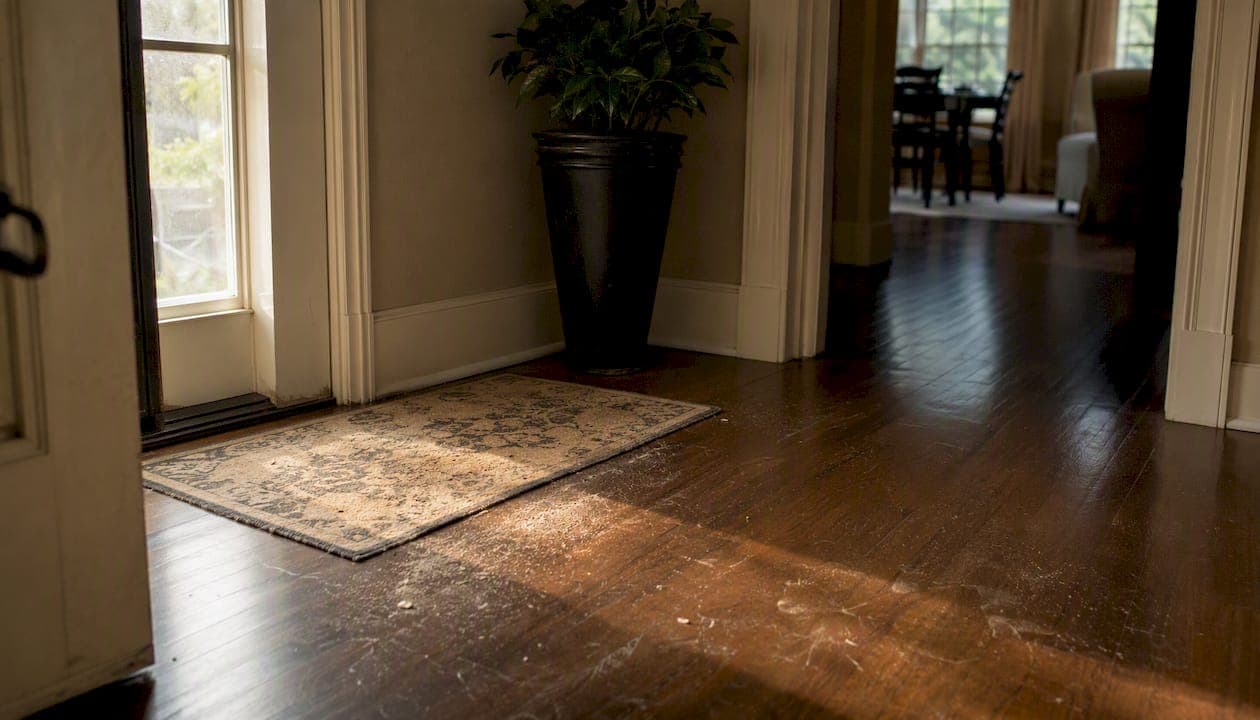
Most homes are dusty because of three overlapping problems: outdoor particles tracked in through doors and shoes, fibres shed by textiles and pets, and an HVAC system that circulates rather than captures what's already airborne. Roughly 60% of indoor dust originates outdoors and enters through infiltration and track-in, while the remaining 40% is generated inside. That split matters because it tells you where to start.
Three things you can do today:
- Swap or inspect your HVAC filter. A clogged filter stops filtering and starts redistributing. If it's grey and matted, replace it now.
- Remove shoes at the door. A walk-off mat extending at least 1.5 metres inside the entry, cleaned weekly, can capture 60–80% of tracked-in soil before it spreads.
- Wet-dust your highest surfaces first. Dry cloths push fine particles back into the air; a damp microfibre cloth traps them.
If dust keeps returning despite these steps, the ductwork is often the culprit. Clean Vents, an INCV-certified duct and vent cleaning service in Laval, Quebec, handles exactly that situation.
Key takeaways
Persistent household dust almost always traces back to three controllable factors: outdoor particles entering through doors and shoes, HVAC systems that circulate rather than capture, and humidity levels that let dust mites thrive.
| Point | Details |
|---|---|
| Prioritise source control | Roughly 60% of indoor dust comes from outdoors; entry mats and a no-shoes rule reduce it faster than any cleaning routine. |
| Replace filters every 1–3 months | A clogged or low-MERV filter redistributes dust; upgrading to MERV 8–11 improves capture in most residential systems. |
| Use wet dusting and HEPA capture | Damp microfibre cloths and HEPA vacuums remove particles; dry dusting and standard vacuums re-suspend them. |
| Keep humidity at 35–50% | This range limits dust-mite populations and reduces airborne particle re-suspension year-round. |
| Call Clean Vents when vents keep shedding dust | Persistent dust rings around registers and rapid re-soiling after cleaning are signs that professional duct cleaning is the next step. |
Table of Contents
- Why is your house so dusty? The main sources and how to spot them
- What household dust is actually made of
- How to clean your home so dust actually leaves
- HVAC, filters, and air cleaners: what actually controls airborne dust
- Humidity, dust mites, and why the 35–50% range matters
- Signs your ducts, dryer vent, or wall AC need professional cleaning
- Your 7-step dust troubleshooting checklist for this week
- A local perspective on Canadian homes and dust
- Persistent dust from your ducts? Clean Vents can help
- Sources
- FAQ
Why is your house so dusty? The main sources and how to spot them
Understanding which source dominates in your home lets you fix the right thing first. Here is a breakdown of the most common contributors, with the diagnostic signal for each.
| Dust source | Typical contribution | What to look for |
|---|---|---|
| Outdoor track-in (shoes, pets) | ~60% of total indoor dust | Heavy dust near entryways, on doormats, and on low surfaces |
| HVAC/duct leakage | 20–30% leakage rate in many homes | Dust rings around supply registers; dusty surfaces shortly after cleaning |
| Carpets and rugs | 200 g/m² embedded | Visible puff of particles when you walk across; persistent dust in carpeted rooms |
| Textiles (bedding, curtains, upholstery) | Significant indoor source | Dust concentrated near sofas, beds, and window treatments |
| Pets and dander | Varies by pet count/breed | Dust heaviest in rooms where pets sleep or spend time |
| Household activities (cooking, candles, incense, smoking) | Adds fine combustion particles | Greasy film on kitchen surfaces; soot near candle locations |
| Nearby construction or road traffic | Seasonal or situational | Sudden increase coinciding with outdoor work; gritty texture to dust |
| Clutter and decorative items | Traps and holds settled dust | Dust accumulates on shelves, figurines, and stacked items |
Outdoor track-in is the single largest source for most Canadian homes. Soil, pollen, and road grit ride in on shoe soles and pet paws. A no-shoes policy combined with quality entry mats makes a measurable difference within days.
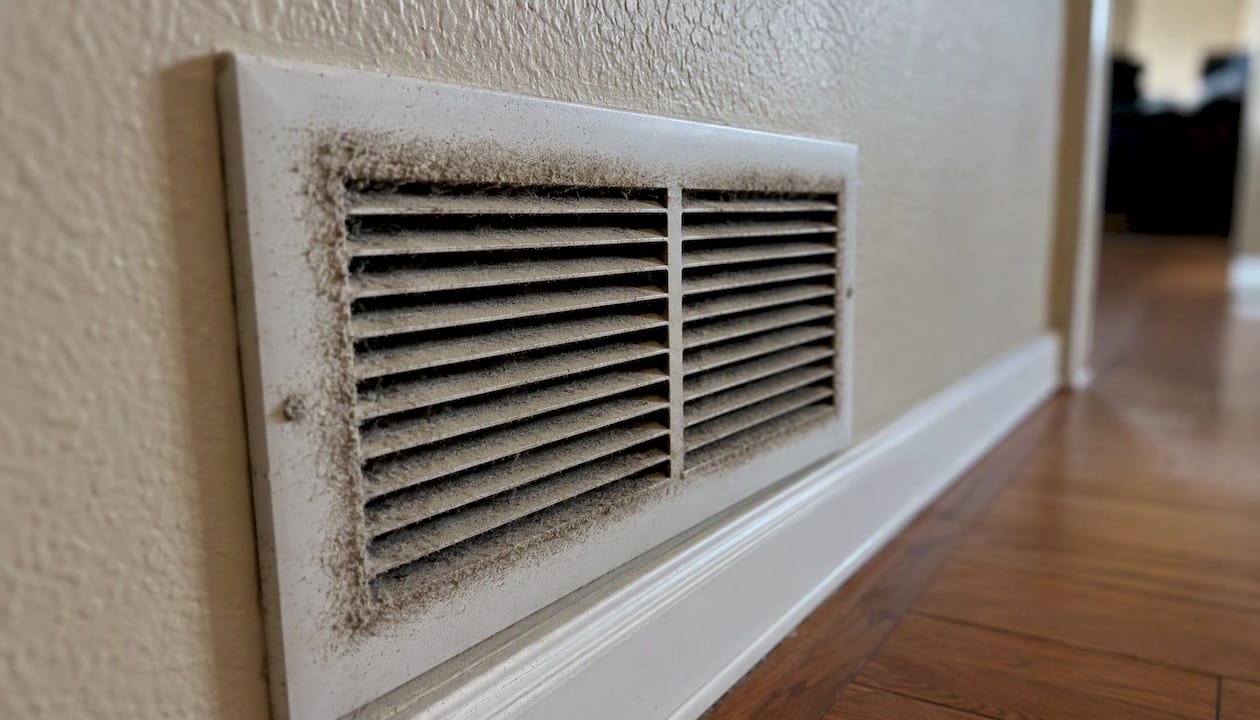
HVAC and duct leakage is the source most homeowners miss. Leaky residential ductwork commonly loses 20–30% of airflow to attics, crawlspaces, or wall cavities, pulling unfiltered air directly into the living space. If your surfaces get dusty again within a day or two of cleaning, check the registers first.
Carpets hold far more dust than they appear to. Hard floors in high-traffic zones are genuinely easier to keep clean.
Cleaning experts confirm that dirty HVAC filters, drafty windows, and shoes worn indoors are among the most common and most fixable contributors to persistent dust accumulation.
What household dust is actually made of
Dust is not mostly dead skin. That is one of the most persistent myths about indoor air quality. Henry Ford Health clinicians describe household dust as a complex mix of dead skin cells, textile fibres, pollen, pet dander, combustion particles, dust-mite fragments, and trace chemicals including PFAS and microplastics.
Why does the composition matter? Because different particles behave differently. Fine particles from combustion or pollen stay airborne for hours and travel through your HVAC system. Heavier particles like soil and textile fibres settle quickly on horizontal surfaces. Dust-mite fragments concentrate in bedding and upholstered furniture, where humidity keeps them viable.
Surface cleaning alone rarely solves the problem because it addresses only what has already settled. The particles still circulating in the air will simply land again within hours. That is why filtration and source control work together, while wiping alone does not.
Allergy and asthma sufferers in particular benefit from addressing all three rather than relying on any single approach.
How to clean your home so dust actually leaves
Wet microfibre trapping combined with HEPA capture and targeted vacuuming removes dust from your home. Dry dusting and standard vacuums mostly move it around.
Weekly tasks
- Dust high-to-low with a damp microfibre cloth. Start at ceiling fans and shelves; finish at baseboards. Gravity does the work of bringing particles down, so you only wipe each surface once.
- Vacuum with a HEPA-certified or sealed-bag vacuum. Wet microfibre and HEPA capture prevent re-suspension of fine particles that cause persistent dust. Empty the dust cup after every session, not once a week.
- Launder bedding on hot. Dust-mite allergens wash out at 60°C. Weekly is the right frequency for pillowcases; every two weeks for duvet covers.
Monthly tasks
- Wash or vacuum curtains and blinds using an upholstery attachment.
- Wipe interior doors, door frames, and light switches with a damp cloth. These surfaces collect a surprising amount of settled dust and are easy to overlook. A gentle cleaner on interior door surfaces keeps finishes intact while removing the film.
- Clean the vacuum filter itself. A clogged filter turns your vacuum into a dust redistributor.
Seasonal tasks
- Wash all throw pillows and blankets.
- Deep-clean upholstered furniture with a HEPA-equipped upholstery tool.
- Check and replace the HVAC filter (more on cadence below).
Pro Tip: Vacuum before you dust, not after. Vacuuming stirs up fine particles that take 20–30 minutes to settle. If you vacuum last, you capture what just landed. If you vacuum first and then dust, you're wiping settled particles onto a surface you just cleaned.
HVAC, filters, and air cleaners: what actually controls airborne dust
The HVAC system can be the single biggest driver of dust accumulation if filters are wrong or ducts leak. Return ducts that draw air from unconditioned spaces, gaps around filter housings, and leaky supply ducts all allow unfiltered air to bypass the filter entirely and blow directly into living areas.
Filter selection and replacement
Experts recommend changing HVAC filters every 1–3 months, with seasonal inspection as a practical benchmark. Standard fibreglass filters capture large particles but miss most of what causes visible dust. Upgrading to a MERV 8–11 filter improves capture of pollen, dust-mite fragments, and pet dander without restricting airflow in most residential systems. MERV 13 and above capture finer particles but require a compatible blower; check your system's specs before upgrading.
| Filter type | Particle size captured | Typical application |
|---|---|---|
| Fibreglass (MERV 1–4) | Larger particles | Basic protection for HVAC equipment |
| Pleated (MERV 8–11) | Particles 1–10 microns | Residential dust, pollen, dander control |
| High-efficiency pleated (MERV 13) | Particles 0.3–1 micron | Allergy households; requires compatible system |
| HEPA (standalone purifier) | Nearly all particles at 0.3 microns | Room-by-room supplemental filtration |
When a portable air purifier helps
Portable HEPA air purifiers capture nearly all particles at 0.3 microns and reduce the amount of airborne dust that settles on surfaces. They work best in a single room, sized appropriately for the square footage. A unit rated for 200 sq. ft. placed in a 500 sq. ft. open-plan space will underperform.
The limitation: a portable purifier cannot compensate for duct leakage. If your ducts are pulling unfiltered air from a crawlspace and blowing it through every register, a purifier in the living room is fighting a losing battle. That is when duct inspection becomes necessary.
Humidity, dust mites, and why the 35–50% range matters
The recommended indoor humidity range for dust and allergen control is 35–50% relative humidity. Above 50%, dust-mite populations rise and mould risk increases. Below 35%, static electricity increases particle re-suspension and occupant discomfort rises.
Practical steps to stay in range:
- Run bathroom exhaust fans for at least 15 minutes after showers.
- Use a dehumidifier in basements during summer months, when ground moisture is highest.
- Monitor with a digital hygrometer (available at most Canadian hardware stores for under $20).
- In winter, a whole-home humidifier on the furnace can prevent the air from dropping too far below 35%.
Signs your ducts, dryer vent, or wall AC need professional cleaning
Call a professional when DIY cleaning stops producing results. Specifically, watch for these signs:
- Dust reappears on surfaces within 24–48 hours of thorough cleaning
- Visible debris, dust rings, or discolouration around supply registers
- Allergy or asthma symptoms worsen at home but improve when you leave
- Dryer takes two or more cycles to dry a normal load (a clogged dryer vent)
- Wall AC units blow air that smells musty or visibly distributes dust
- You have never had ducts cleaned and the home is more than five years old
What professional duct cleaning typically includes: a technician inspects accessible ductwork, uses high-powered source-removal vacuuming to extract debris from supply and return ducts, brushes dryer vent lines clear of lint, and cleans wall AC filters and coils. INCV-certified technicians follow a documented process with before-and-after verification. Duct sealing, where gaps are identified and sealed, is often offered as an add-on and addresses the leakage that drives persistent dust re-entry.
Pro Tip: Before a duct cleaning visit, move furniture away from floor registers and make sure all registers are accessible. Seal pets in a separate room during the service. Take a photo of your dustiest register before the technician arrives — it gives you a clear before-and-after reference and helps the technician prioritise.
What to expect during a visit: most residential duct cleaning jobs take two to four hours depending on system size. A reputable provider will show you what was removed and explain any duct sealing recommendations. Clean Vents offers upfront flat-rate pricing and a satisfaction guarantee, so there are no surprises on the invoice. For more on what duct debris looks like and why it matters, see what air duct debris does to your airflow and health.
Your 7-step dust troubleshooting checklist for this week
Work through these in order. Each step either solves the problem or narrows down what's left.
- Place entry mats and enforce a no-shoes rule. Set a mat at every exterior door and ask household members to remove shoes on entry. Give it three days and check whether dust near entry points decreases.
- Inspect and replace the HVAC filter. Pull the filter out. If it is visibly grey or matted, replace it with a MERV 8 or higher. Note the date on the frame.
- Vacuum all carpeted areas with a HEPA vacuum. Focus on high-traffic paths and under furniture. Empty the dust cup immediately after.
- Wet-dust all horizontal surfaces high-to-low. Use a damp microfibre cloth. Work room by room, starting with the dustiest spaces.
- Check every supply and return register. Look for dust rings, debris, or discolouration. Photograph any that look heavily soiled.
- Run a HEPA air purifier in the bedroom overnight and check whether morning allergy symptoms improve. If they do, fine particles are a significant factor.
- Measure humidity with a hygrometer. If readings are consistently above 50%, run a dehumidifier. If below 35% in winter, consider a furnace humidifier.
After completing all seven steps, review your register photos. If registers are visibly dirty and dust is still returning quickly, that is the signal to move from DIY to professional service. The checklist is done; the ductwork needs attention.
A local perspective on Canadian homes and dust
What Clean Vents technicians see most often in Laval and the surrounding Quebec region is not unusual dust sources — it is the combination of tight winter sealing and neglected ductwork. When homes are sealed up from October through April, the stack effect pulls air upward through the building envelope, drawing unfiltered air from attics and lower-level gaps into the living space. That same sealed environment means whatever enters the duct system circulates continuously with nowhere to escape.
Construction dust is another recurring pattern in the greater Montreal area, where renovation activity is constant. Fine drywall and concrete particles are particularly stubborn because they are light enough to stay airborne for extended periods and small enough to pass through low-MERV filters. Homeowners who have recently renovated and notice persistent fine white dust on surfaces should treat duct inspection as a priority, not an afterthought.
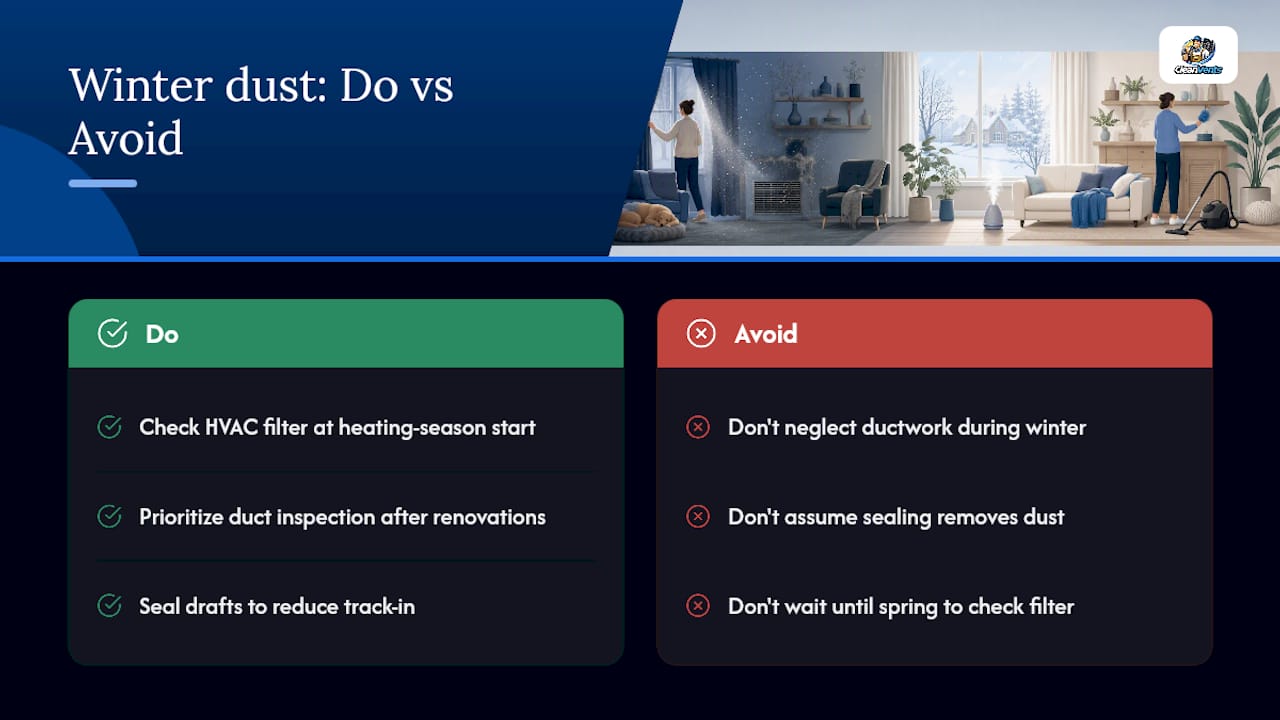
The practical reminder for Canadian homes: winter is when dust problems compound. Sealing drafts reduces track-in but also traps what is already circulating. Checking the HVAC filter at the start of the heating season, not just in spring, is the single most impactful maintenance habit for reducing dust accumulation through the coldest months.
Persistent dust from your ducts? Clean Vents can help
When dust keeps returning despite filter changes and regular cleaning, the duct system is usually the reason. Debris and leakage in the ductwork mean your HVAC is redistributing particles every time it runs, and no amount of surface cleaning fixes that at the source.
Clean Vents provides professional air duct cleaning, dryer vent cleaning, and wall AC cleaning for residential and commercial properties in Laval and the surrounding Quebec region. Technicians are INCV-certified, pricing is flat-rate with no hidden fees, and every job comes with a satisfaction guarantee. Services cover the full system: supply and return ducts, registers, dryer vent lines, and wall-mounted AC units.
To book a free quote or schedule a visit, contact Clean Vents directly through Cleanvents.
Sources
- Indoor Dust Sources in Homes: Causes and Effective Control Methods
- How to reduce exposure to dust in your home | Henry Ford Health
- Cleaning experts explain why your house always feels dusty (Good Housekeeping)
- Hvac
This article is general information, not a substitute for advice from a qualified doctor. Consult a qualified healthcare professional about your own circumstances before acting on anything here.
FAQ
How do I stop my house from being so dusty?
Start with source control: use entry mats, remove shoes at the door, and replace your HVAC filter with a MERV 8 or higher. Switch to wet microfibre dusting and a HEPA vacuum so particles are removed rather than redistributed.
Why is there so much dust in my house all of a sudden?
A sudden increase usually points to a new source: nearby construction, a recently changed season (pollen, dry winter air), a failing HVAC filter, or a dryer vent that has become clogged. Check your filter first, then look for any recent changes indoors or outdoors.
Is it unhealthy to live in a dusty house?
Yes, over time. Household dust contains allergens, dust-mite fragments, pollen, and trace chemicals.
What is the simplest trick to reduce dust quickly?
Place a quality walk-off mat at every exterior entry and enforce a no-shoes rule.
When should I call a professional about dust in my home?
Call a professional when dust returns within 24–48 hours of thorough cleaning, when you see debris or dust rings around registers, or when allergy symptoms worsen at home. These are signs that the duct system is the source, and surface cleaning alone will not resolve it.