
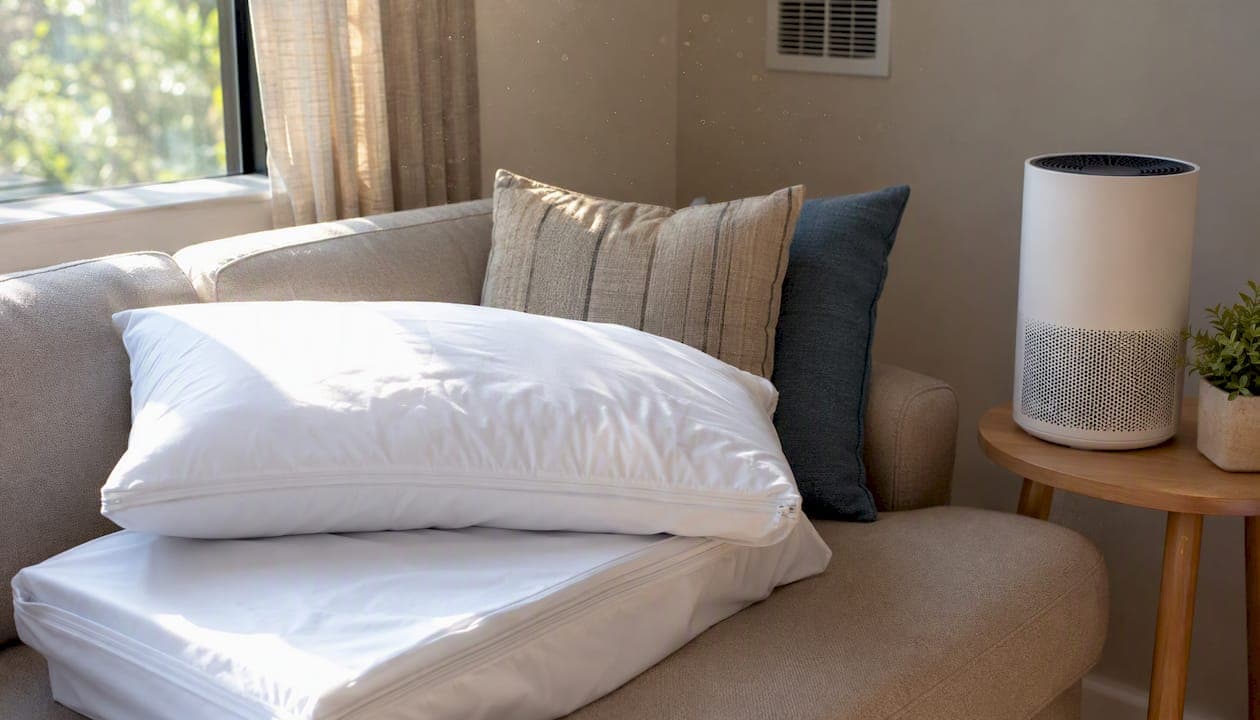
The fastest way to reduce indoor allergy symptoms is to cut off the allergens at their source. Encase your mattress and pillows in allergen-proof covers, wash all bedding weekly at a minimum of a temperature sufficient to kill dust mites, run a HEPA air purifier in your bedroom, keep indoor humidity at a level recommended to limit dust mite and mould growth, and ban pets from sleeping areas. Those five steps address the highest-concentration allergen zones in most Canadian homes, and you can start all of them today.
According to the Asthma and Allergy Foundation of America, HEPA-equipped vacuums and certified air purifiers are effective tools for reducing settled and airborne allergens, and keeping pets out of the bedroom is one of the single most impactful changes a pet owner can make.
Start this hour:
- Put allergen-proof encasements on your mattress, box spring, and pillows
- Strip and wash all bedding at ≥54°C/130°F
- Move pets out of the bedroom and close the door
Today:
- Place a HEPA air purifier in your bedroom and set it to run continuously
- Check your bathroom and basement for visible moisture or mould
This week:
- Buy a hygrometer and confirm your indoor relative humidity sits between 30–50%
- Replace your HVAC filter if it has been more than 90 days
- Schedule a damp-dusting pass through the bedroom and living room
Table of Contents
- How do you identify which allergen is causing your symptoms?
- Room-by-room checklist for reducing indoor allergens
- Cleaning routines and laundry practices that cut allergen reservoirs
- How to choose air purifiers, HVAC filters, and vacuums
- How to control moisture, mould, and pests
- Living with pets and personal hygiene measures
- Medication, immunotherapy, and how long improvements take
- When is professional HVAC or duct cleaning worth it?
- How long do improvements take, and what do they cost in Canada?
- Key takeaways
- Why targeted HVAC cleaning fits into a broader allergy plan
- Clean Vents: professional air quality services in Laval, Quebec
- Useful sources and further reading
How do you identify which allergen is causing your symptoms?
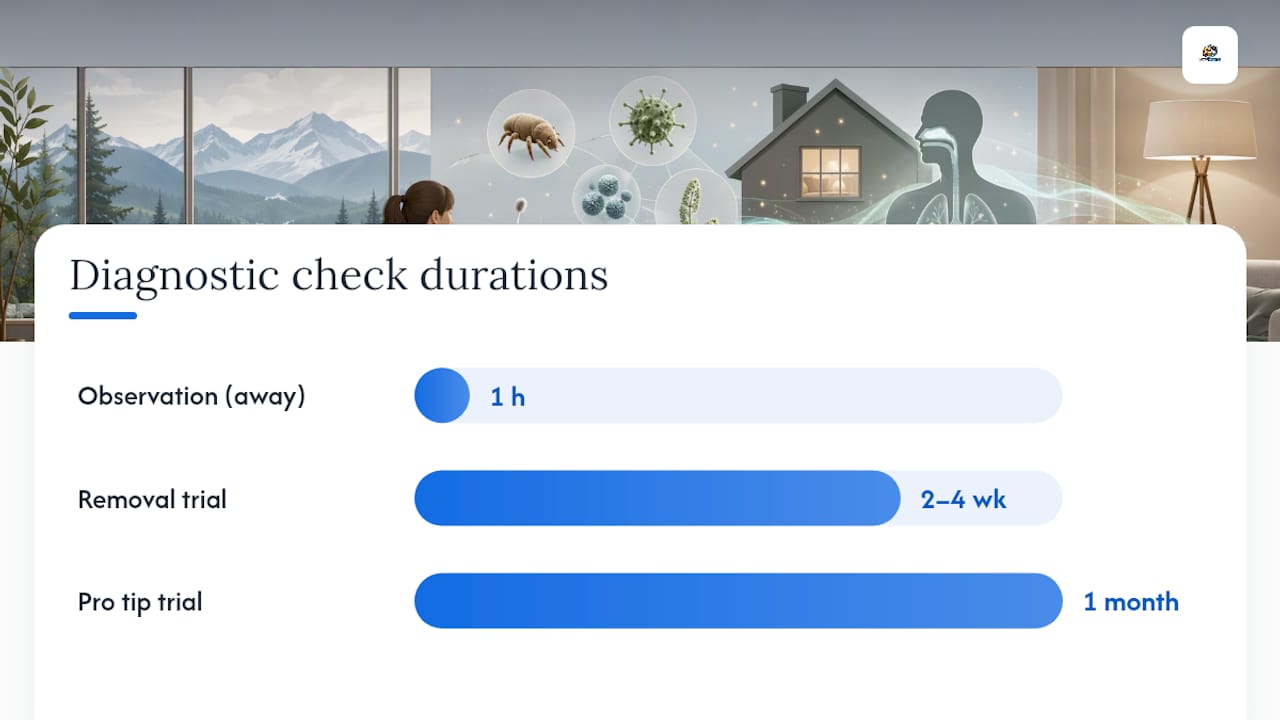
Pinpointing the culprit before spending money on equipment saves a lot of effort. Start with observation.
- Track when and where symptoms worsen. Morning sneezing that clears after an hour away from home points strongly to dust mites or pet dander in the bedroom. Symptoms that spike in the basement or bathroom suggest mould.
- Note room-specific patterns. If your nose runs every time you sit on the couch but not at your desk, the upholstered furniture is a likely reservoir.
- Connect symptoms to recent changes. New pet, recent renovation, a leak that was "fixed" months ago, a new carpet — any of these can introduce or amplify an allergen source.
- Try a removal trial. Remove the suspected source or move out of the room for two to four weeks. If symptoms improve measurably, you have your answer. This costs nothing and is often more informative than a home test kit.
- Use home test kits with realistic expectations. Dust mite and mould test kits are available at most Canadian pharmacies. They can confirm the presence of an allergen but cannot tell you whether that level is clinically significant for your immune system.
- See an allergist for a definitive diagnosis. Skin prick tests and specific IgE blood tests (such as the ImmunoCAP panel) identify exactly which proteins your immune system reacts to. The AAAAI notes that avoidance is the primary treatment, and you cannot practise targeted avoidance without knowing what you are avoiding.
Pro Tip: Before booking any equipment or professional service, do the two-to-four-week removal trial first. Sleeping in a different room, removing a rug, or keeping the cat out of the bedroom for a month costs nothing and tells you more than most test kits will.
Room-by-room checklist for reducing indoor allergens
Bedroom
The bedroom is where most people spend much of their night, which makes it the highest-value room to address first. Practical household tips consistently point to the bedroom as the priority zone.
- Encase mattress, box spring, and all pillows in zippered allergen-proof covers and leave them on permanently
- Wash sheets, pillowcases, and blankets weekly at a suitable hot temperature and dry on a hot cycle
- Remove wall-to-wall carpeting if possible; use washable, low-pile rugs instead
- Place a HEPA air purifier near the bed and run it on a medium or high setting overnight
- Keep all pets out of the bedroom and keep the door closed
Living room
- Prefer hard flooring (hardwood, tile, laminate) over wall-to-wall carpet; if carpet stays, vacuum twice weekly with a HEPA-sealed vacuum
- Choose leather, vinyl, or tightly woven fabric for furniture over heavily textured upholstery that traps dander
- Reduce decorative fabric items: heavy drapes, throw pillows, and fabric wall hangings are dust reservoirs
- Wipe down hard surfaces with a damp microfibre cloth weekly rather than dry-dusting, which sends particles airborne
Kitchen
- Store all dry food in sealed containers to eliminate cockroach food sources
- Wash dishes promptly and do not leave pet food in open bowls overnight
- Run the range hood fan while cooking to vent moisture and combustion particles
- Repair any dripping taps or cabinet leaks immediately to prevent mould behind cabinetry
Bathroom
- Run the exhaust fan during and for 15 minutes after every shower
- Wipe down tile grout and caulking monthly; clean visible mould with a detergent solution promptly
- Use washable cotton bath mats rather than permanent rugs that stay damp
- Keep the toilet lid closed and the room well ventilated to reduce humidity spikes
Basement and garage
- Run a dehumidifier and keep humidity below 50% year-round
- Remove cardboard boxes, old newspapers, and porous items stored directly on concrete floors
- Inspect the perimeter for cracks or gaps where moisture or pests can enter
- If you find mould on drywall or insulation covering more than roughly 0.9 square metres (10 sq ft), call a professional remediator rather than attempting DIY removal
Cleaning routines and laundry practices that cut allergen reservoirs
The goal of cleaning for allergy management is not just visual tidiness. It is physically removing allergen proteins from surfaces before they become airborne.
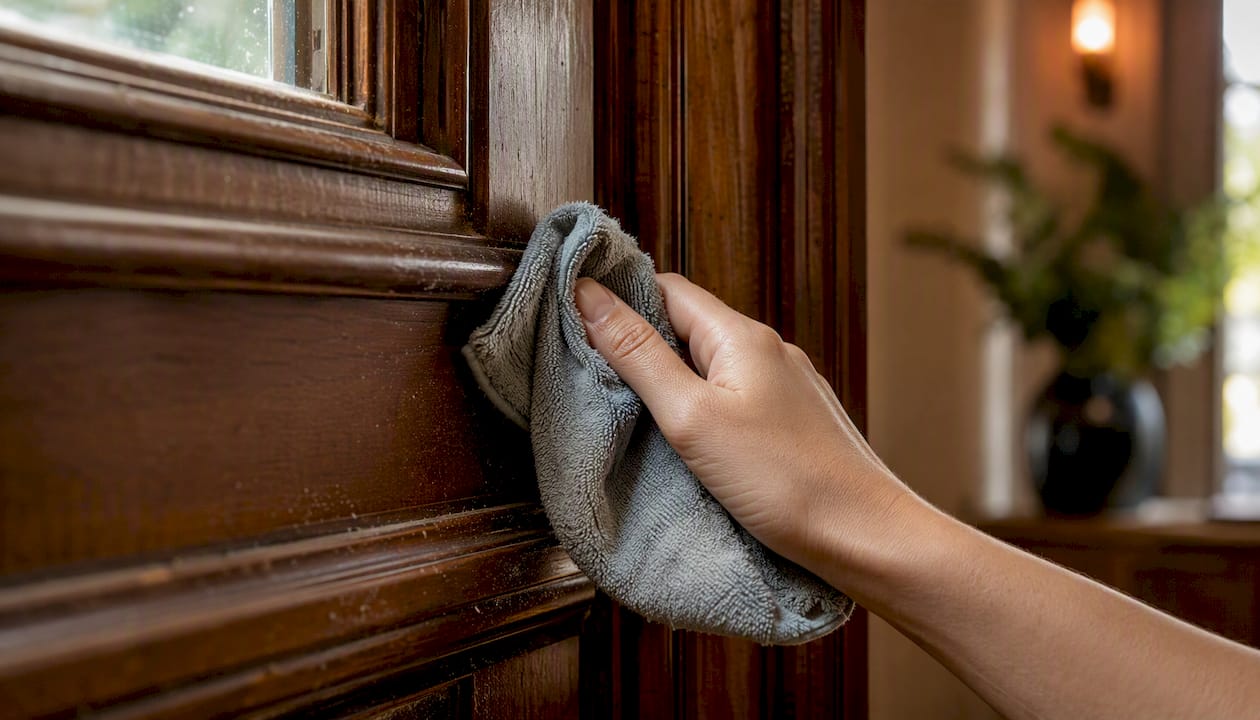
- Damp-dust all hard surfaces — A dry cloth or feather duster lifts particles off a surface and puts them straight into the air you breathe. A damp microfibre cloth traps them. The Mayo Clinic recommends this specifically for allergy management.
Pro Tip: Build a simple weekly schedule: Monday, damp-dust all bedroom surfaces; Wednesday, wash bedding; Friday, vacuum all carpets and upholstered furniture. Monthly, wipe down baseboards, ceiling fan blades, and the tops of door frames. Those are the spots that accumulate the most settled dust between regular cleans.
For doors and trim, which accumulate dust in grooves and panels, a low-dust approach to cleaning interior surfaces using a damp cloth prevents the same particle-aerosolisation problem.
How to choose air purifiers, HVAC filters, and vacuums
HEPA purifiers and vacuums
HEPA stands for High Efficiency Particulate Air. A true HEPA filter captures 99.97% of particles at 0.3 microns, which covers dust mite allergen fragments, pet dander, and mould spores. For portable purifiers, match the unit's Clean Air Delivery Rate (CADR) to your room size. A bedroom of roughly 15 square metres needs a CADR of at least 150 cubic metres per hour.
For vacuums, the sealed system matters as much as the filter. A HEPA filter in a vacuum with leaky seams still exhausts fine particles through the casing. Look for vacuums carrying the Asthma & Allergy Friendly® certification from the Allergy Standards Limited programme, which tests the whole machine rather than just the filter.
HVAC filters and MERV ratings
| Filter type | MERV rating | What it captures | Trade-off |
|---|---|---|---|
| Basic fibreglass | 1–4 | Large dust and lint only | Minimal allergen benefit |
| Standard pleated | — | Dust mite debris, pollen, mould spores | Good balance for most homes |
| High-efficiency pleated | — | Fine particles, pet dander, bacteria | May reduce airflow in older systems |
| HEPA-grade (standalone unit) | — | Near-total particle capture | Requires system modification |
For most Canadian forced-air systems, a MERV 11 pleated filter changed every 60–90 days is the practical sweet spot. Going to MERV 13 is worthwhile if you have pets or a household member with asthma, but confirm your furnace can handle the reduced airflow first.
Placement and operating tips:
- Run bedroom purifiers overnight at medium or high speed
- Set your wall AC or central system to recirculate (not fresh-air intake) during high outdoor pollen periods in spring and fall
- Change HVAC filters on a calendar reminder, not when they look dirty — a clogged filter redistributes rather than captures
The GOV.UK indoor allergen guidance reinforces that active air cleaning combined with ventilation management is one of the most effective behaviour-change measures for reducing airborne allergen exposure.
How to control moisture, mould, and pests
Humidity targets
Keep indoor relative humidity at recommended levels to control dust mites and mould. Below 30%, skin and airways dry out; above 50%, dust mites reproduce faster and mould becomes a real risk. A basic digital hygrometer (available at most Canadian hardware stores for under $20) tells you exactly where you stand. The Mayo Clinic's allergy guidance specifically recommends this range for limiting both dust mite and mould growth.
Run a dehumidifier in your basement from May through October. In a Canadian winter, your forced-air heating system typically dries indoor air enough that a humidifier may actually be needed — monitor rather than assume.
Mould remediation steps
- Fix the water source first. Cleaning mould without stopping the moisture is pointless.
- For small areas (under roughly 0.9 sq m / 10 sq ft), scrub with a detergent solution or a 5% bleach solution, dry thoroughly, and improve ventilation.
- For larger areas, or mould inside walls, insulation, or HVAC components, hire a certified professional. Disturbing large mould colonies without containment spreads spores through the entire house.
- After remediation, monitor humidity monthly and re-inspect the area at 30 and 90 days.
Pest control
Cockroach and rodent allergens are among the most potent triggers for asthma, particularly in urban multi-unit buildings. Sanitation is the foundation: sealed food storage, prompt dishwashing, and eliminating standing water remove the food and moisture that sustain infestations. Seal gaps around pipes, baseboards, and entry points with caulk or steel wool. If traps and bait stations do not resolve the problem within two to three weeks, a licensed exterminator is the next step.
Humidity target: Keeping indoor relative humidity at 30–50% is one of the most cost-effective steps you can take. It simultaneously suppresses dust mite reproduction and mould growth without any equipment beyond a hygrometer and a dehumidifier.
Living with pets and personal hygiene measures
Pet management
The idea of a truly hypoallergenic pet breed is a myth. Allergens come from proteins in saliva, urine, and skin flakes, not from fur length or breed. The AAFA is direct on this point: no pet is allergen-free, and the most effective strategy is source reduction combined with cleaning discipline.
- Keep pets out of the bedroom at all times and keep the bedroom door closed
- Bathe dogs weekly if possible; have a non-allergic household member do the bathing and grooming
- Wash pet bedding weekly at a temperature sufficient to reduce allergens
- Avoid letting pets sleep on upholstered furniture; if that is not realistic, use washable slipcovers and launder them weekly
- After handling pets, wash hands before touching your face
Personal hygiene and entryway habits
Outdoor allergens, including pollen and mould spores, hitch rides indoors on clothing, hair, and shoes. A few consistent habits cut that transfer significantly.
- Remove shoes at the door and store them in a closed cabinet or on a mat outside
- Change clothes after coming in from high-pollen outdoor activities, especially during spring and fall
- Shower before bed during peak pollen periods to avoid transferring pollen to your pillow
- Nasal saline irrigation (using a neti pot or squeeze bottle with sterile saline) rinses allergens from nasal passages and is a well-tolerated adjunct to medication
Pro Tip: Set up a dedicated entryway routine: a doormat outside, a shoe rack inside, and a hook for outerwear that stays near the door rather than being carried through the house. Add a small basket for a change of clothes during pollen season. It takes about 30 seconds and prevents a meaningful amount of allergen transfer.
Medication, immunotherapy, and how long improvements take
Immunotherapy
According to the AAAAI, immunotherapy is the only medical option that can actually change how your immune system responds to an allergen over time. Allergy shots (subcutaneous immunotherapy) and sublingual drops or tablets both require specialist supervision and a confirmed diagnosis. The build-up phase typically takes several months; the full maintenance phase runs three to five years. It is not a quick fix, but for people with multiple sensitivities or severe symptoms, it is the only path to lasting change.
Timeline callout
Symptom duration after allergen exposure varies considerably. Brief exposures can trigger reactions lasting minutes; chronic, ongoing exposure can produce sustained nasal and airway inflammation that may take days to weeks of reduced exposure to resolve.
Environmental changes like encasements and HEPA filtration often produce noticeable improvement within one to two weeks. Humidity control and mould remediation may take a month or more before the full benefit is felt. Immunotherapy is measured in months to years.
When to see an allergist: persistent symptoms despite four to six weeks of consistent home measures, any wheeze or shortness of breath, frequent sinus infections, or symptoms that significantly affect sleep or daily function.
When is professional HVAC or duct cleaning worth it?
Professional duct and vent cleaning is not a universal solution for indoor allergy relief, but it is the right call in specific situations. Clean Vents' guide for Canadian homeowners outlines the clearest indicators.
Hire a professional when you have:
- Visible mould growth inside ducts or on duct surfaces
- Evidence of rodent or insect infestation in the ductwork
- Significant debris accumulation following a renovation or construction project
- Persistent dusty or musty airflow from vents despite regular filter changes
- A documented reduction in airflow that suggests debris build-up in the system
When professional cleaning has low impact:
- Isolated allergen sources (a single dusty mattress, a mouldy bathroom caulk line) that are not connected to the HVAC system
- A recently cleaned system with no contamination indicators
- Homes where the primary allergen source is pet dander on furniture rather than distributed through forced air
What to ask a contractor
- Are your technicians INCV-certified? (The Institut National de la Construction en Ventilation sets the Canadian industry standard for duct cleaning.)
- Can you provide before-and-after photos of the duct interior?
- Do you use nozzle-level inspection and containment to prevent debris from spreading during cleaning?
- Will you provide a written scope of work before starting?
Pro Tip: Schedule professional duct cleaning outside your peak allergy season if possible. Having the work done in late summer or early fall means the system is clean before you seal the house for winter and start recirculating indoor air continuously.
How long do improvements take, and what do they cost in Canada?
| Intervention | Time to noticeable effect | Approximate Canadian cost |
|---|---|---|
| Mattress and pillow encasements | 1–2 weeks | $50–$150 per set |
| HEPA portable air purifier | 1–2 weeks | $150–$500 depending on room size |
| Dehumidifier (basement) | 2–4 weeks | — |
| Professional air duct cleaning | 2–6 weeks | — |
| Allergen-proof bedding replacement | 2–4 weeks | — |
| Allergy immunotherapy | 6 months for initial benefit | Varies; partially covered by many provincial plans |
Cost-effectiveness matters when you are working through a list of interventions. Mattress and pillow encasements are among the highest-impact, lowest-cost steps available. A quality HEPA purifier for the bedroom delivers measurable benefit for most allergen types. Professional duct cleaning earns its cost specifically when the HVAC system is a confirmed allergen distribution point, not as a first step for everyone.
A phased approach makes sense for most households: start with the bedroom (encasements, hot washing, HEPA purifier), then address humidity and mould, then evaluate whether the HVAC system needs attention. Spending $500 on duct cleaning before fixing a leaking bathroom pipe is the wrong order.
Note: Cost ranges above reflect general Canadian market estimates and will vary by region, home size, and supplier. Get local quotes before budgeting.
Key takeaways
The single most effective strategy for indoor allergy relief is to reduce allergen load at its source, starting with the bedroom, before adding filtration or medication.
| Point | Details |
|---|---|
| Bedroom first | Encase mattress and pillows permanently; wash bedding weekly at ≥54°C/130°F for maximum dust mite reduction. |
| HEPA filtration matters | Use a HEPA purifier in the bedroom overnight and a HEPA-sealed vacuum on carpets and upholstery twice weekly. |
| Hold humidity at 30–50% | A hygrometer and dehumidifier in damp areas suppresses both dust mite reproduction and mould growth simultaneously. |
| See an allergist when home measures stall | Persistent symptoms after four to six weeks of consistent changes warrant skin prick or IgE testing and a discussion of immunotherapy. |
| Clean Vents for HVAC allergen control | When ducts show visible mould, post-renovation debris, or persistent dusty airflow, professional INCV-certified cleaning from Clean Vents addresses the distribution source. |
Why targeted HVAC cleaning fits into a broader allergy plan
Most allergy advice focuses on surfaces you can see and touch: bedding, carpets, upholstery. That is the right place to start. But in a Canadian home with forced-air heating, the duct system is the circulatory system of your indoor air. If it is carrying accumulated dust, mould fragments, or post-renovation debris, every time the furnace runs it redistributes those particles through every room you have just cleaned.
That is the specific problem professional duct and vent cleaning solves. It does not replace encasements or HEPA filtration. It addresses the distribution mechanism that undermines those other steps when the system itself is contaminated.
Clean Vents focuses on exactly this part of the problem: air duct cleaning, dryer vent cleaning, and wall AC cleaning for homes in Laval and the surrounding area, performed by INCV-certified technicians who inspect at the nozzle level and provide before-and-after documentation. The value is not in cleaning for its own sake. It is in removing a confirmed contamination source from the system that touches every room.
For most households, duct cleaning belongs in the second or third phase of an allergy management plan, after the bedroom is addressed and humidity is under control. When the indicators are there (visible mould, post-renovation dust, persistent musty airflow), it is one of the more targeted interventions available.
Clean Vents: professional air quality services in Laval, Quebec
Cleaner ducts mean the air your HVAC pushes through every room is not carrying the allergens you just removed from your bedding and floors.
Clean Vents provides professional air duct cleaning, dryer vent cleaning, and wall-mounted AC cleaning for residential and commercial properties in Laval, Quebec. Each service targets a specific allergen distribution point: ducts carry dust and mould fragments through the whole house, dryer vents accumulate lint and moisture that can harbour mould, and wall AC units trap dander and spores directly in the airflow path of a single room.
All work is performed by INCV-certified technicians with upfront flat-rate pricing and a satisfaction guarantee. No surprise charges, no vague scope.
If your home has had recent renovations, persistent dusty airflow, or you have not had the system inspected in several years, request a free quote from Clean Vents to find out whether your ducts are contributing to your symptoms.
Useful sources and further reading
- Control Indoor Allergens to Improve Indoor Air Quality
- Allergy-proof your home - Mayo Clinic
- Indoor Allergens | AAAAI
- Indoor airborne allergens - GOV.UK
- Tips for Reducing Indoor Allergy Triggers at Home | Trinity Health System
- Air duct cleaning: what Canadian homeowners need to know
This article provides general information for educational purposes. It is not a substitute for advice from a qualified medical professional or allergist. Consult a physician or certified allergist for diagnosis and treatment recommendations specific to your situation.