

Most commercial duct cleaning in Canada is priced by the hour or by the square foot, and a realistic budget for a typical job runs from a few thousand dollars, depending on building size, contamination level, and access. HomeStars reports that commercial hourly rates typically fall around typical hourly technician rates, though most contractors will not commit to a final number without an on-site estimate first.
Before you call anyone, have two things ready to ask for: a camera inspection of the ductwork and a written, itemized quote. Those two requests alone will filter out most low-quality bids.
Quick budget benchmarks:
- Small office suite (under 2,000 sq ft): a few hundred to around one thousand five hundred dollars, typically completed in a half-day with a two-person crew
- Restaurant kitchen exhaust system: roughly one and a half to four thousand dollars or more, priced separately from the main HVAC due to grease degreasing requirements
- Mid-size warehouse or multi-zone commercial space (10,000–25,000 sq ft): several thousand dollars and up, often requiring multiple days and a larger crew
These are budgeting anchors, not fixed prices. The only way to get an accurate number for your specific building is an on-site walkthrough.
Key takeaways
Commercial duct cleaning in Canada typically costs a range of several thousand dollars for most mid-size jobs, priced by the hour (typical hourly rates around mid-range prices) or by the square foot (a range from low to about half a dollar per square foot), and no accurate quote is possible without an on-site estimate.
| Point | Details |
|---|---|
| Typical cost range | Most commercial jobs in Canada fall between $1,500 and $6,000 depending on size, contamination, and access. |
| Pricing models | Expect hourly (typical hourly technician rates/technician), per square foot (a range from low to about half a dollar per square foot), or per system/zone quotes depending on job scale. |
| Must-ask quote items | Request camera inspection, before/after photos, itemized pricing, proof of insurance, and WSIB/CNESST documentation in writing. |
| Reduce cost by bundling | Combining duct, coil, and dryer vent cleaning in one visit lowers mobilization costs; recurring contracts reduce per-visit rates further. |
| Clean Vents | INCV-certified commercial duct cleaning in Laval with written quotes, camera inspection, and bundled service options. |
Table of Contents
- What does commercial duct cleaning actually cost in Canada?
- How providers price commercial duct cleaning and the factors that move price
- What a commercial duct cleaning quote usually includes
- How often should commercial ducts be cleaned?
- How to get an accurate on-site estimate and reduce your cost
- What to expect on the day of service
- Why certified local specialists reduce your procurement risk
- Get an on-site commercial duct cleaning estimate from Clean Vents
- Sources
- FAQ
What does commercial duct cleaning actually cost in Canada?
Published pricing surveys show total project costs ranging from roughly $1,500 on the low end to $6,000 or more for larger or more complex jobs, with labour and equipment making up the bulk of that figure.
The table below gives realistic ranges by building type. These figures reflect Canadian market conditions and assume standard access and no major contamination issues.
A few things worth noting about regional variability: labour rates in Montréal, Toronto, and Vancouver tend to run higher than in smaller markets. In Laval and the greater Montréal area, commercial duct cleaning cost is generally in line with Québec averages, though after-hours work and bilingual documentation requirements can add to the total. Budget for the higher end of any range if your building is in a major urban centre or if access is restricted.
How providers price commercial duct cleaning and the factors that move price
Commercial pricing is less standardised than residential work, and you will encounter three main models when collecting quotes.
The three main pricing models
1. Hourly rate per crew The most common model for small-to-mid commercial jobs in Canada. At typical hourly rates around mid-range prices per hour, a two-person crew running eight hours costs $800–$1,200 in labour alone before equipment and materials. This model works in your favour when the job is straightforward and well-scoped; it works against you when access is difficult or the system is more contaminated than expected.
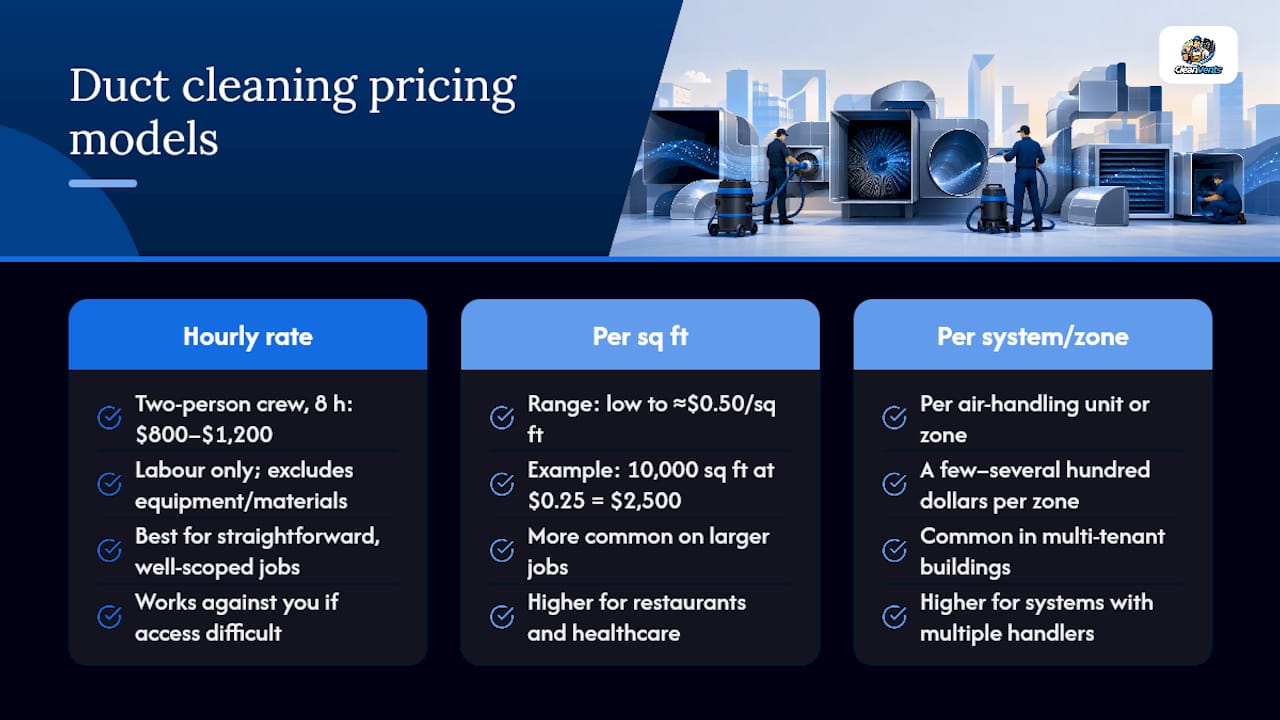
2. Per square foot Many providers quote a range from low to about half a dollar per square foot for commercial work, with restaurants and healthcare facilities at the high end of that range. A 10,000 sq ft office at $0.25/sq ft comes to $2,500 before extras. Per-square-foot pricing is more common on larger jobs because it better captures scale and access variability than counting individual vents.
3. Per system or per zone Some providers price by the number of air handling units, rooftop units, or defined zones. This model is common in multi-tenant buildings or facilities with clearly separated HVAC systems. Expect a few hundred to several hundred dollars per zone as a rough guide, though complex systems with multiple air handlers will sit at the higher end.
What actually drives the final number
The pricing model is just the frame. These are the factors that move the number up or down:
- Contamination level. Grease-laden kitchen ducts, visible mould, or heavy dust from a recent renovation all require more labour, specialized chemicals, and sometimes containment barriers. Mould remediation is typically quoted as a separate line item.
- Accessibility. Ducts running through concrete ceilings, above drop tiles in occupied spaces, or through mechanical rooms with tight clearances add crew time. Access panel creation is often billed separately.
- Ceiling height and duct configuration. High-bay warehouses and industrial facilities require scaffolding or lifts, which adds equipment rental cost.
- Number of zones and air handling units. Each additional air handler or rooftop unit adds scope. A building with six rooftop units is not six times the work, but it is meaningfully more than one.
- After-hours or weekend work. If your building cannot be taken offline during business hours, expect a premium of a significant premium for evening or weekend scheduling.
- Regulatory requirements. Kitchen exhaust systems must comply with NFPA 96 inspection and cleaning schedules, which drives frequency and cost. Healthcare facilities may require additional documentation and containment.
Example calculation for a mid-size office: A 5,000 sq ft office with two rooftop units, standard access, and no contamination issues might look like this: two technicians at $65/hour for eight hours ($1,040 in labour) plus equipment and negative-air machine rental ($300–$500) plus register and plenum cleaning materials ($150–$250). Total before tax: roughly $1,490–$1,790. Add mould treatment or after-hours scheduling and that number climbs quickly.
What a commercial duct cleaning quote usually includes
A properly scoped commercial quote should cover the following without additional charge: a visual inspection of accessible ductwork, setup and containment, negative-air vacuuming of the main duct runs, cleaning of supply and return registers, plenum cleaning, and before/after photos with a written scope of work. Camera inspection and documented photos are standard trust signals that protect you from scope creep and give you a record for insurance or compliance purposes.
What is typically not included in a base quote:
- Antimicrobial or sanitizing treatments: additional cost depending on system size
- Mould remediation: Quoted separately; costs vary widely based on extent
- Kitchen grease degreasing: Almost always a separate line item, often roughly one and a half to four thousand dollars or more
- Coil cleaning: Add additional charges per air handler
- Access panel creation: charges per access panel created in ductwork
- Asbestos or lead testing: Required in older buildings; a few hundred dollars or more for testing
- After-hours premiums: a premium surcharge on labour for after-hours work
- Waste disposal and filter replacement: Sometimes included, often not
Industry guides warn that hidden extras like containment, access modifications, and disposal fees can add hundreds or thousands to an estimate that looked reasonable on paper.
Pro Tip: Before signing any quote, ask the contractor to list every service included in the base price and every service that would trigger a change order. Get that list in writing. A contractor who hesitates to itemize is a contractor who will surprise you on invoice day.
How often should commercial ducts be cleaned?
Frequency depends on building use, occupancy density, and what the system is moving through it. The table below gives practical starting points.
| Building type | Recommended interval | Notes |
|---|---|---|
| General office | Every 3–5 years | Adjust for high occupancy or renovation activity |
| Retail space | Every 2–4 years | Higher foot traffic accelerates dust accumulation |
| Restaurant (main HVAC) | Every 2–3 years | Kitchen exhaust is separate and more frequent |
| Restaurant kitchen exhaust | Every 3–12 months | NFPA 96 compliance; frequency depends on cooking volume |
| Healthcare or clinic | Every 1–2 years | Stricter indoor air quality standards apply |
| Warehouse or industrial | Every 3–5 years | Adjust for dust-generating processes or chemical use |
NFPA 96 sets mandatory inspection and cleaning intervals for commercial kitchen exhaust systems, and those intervals are driven by cooking volume rather than a fixed calendar. A high-volume fryer operation may need quarterly cleaning; a low-volume café kitchen might qualify for annual service. Non-compliance is a fire code issue, not just a maintenance preference.
Beyond the calendar, certain conditions require immediate cleaning regardless of when the last service was done:
- Visible mould growth inside ducts or on registers
- Active or recent water intrusion into the duct system
- Confirmed grease buildup in kitchen exhaust systems
- Post-construction or major renovation dust contamination
- Persistent occupant complaints about air quality or odour
- A failed indoor air quality assessment
For restaurant and food service operators, coordinating kitchen exhaust cleaning with a commercial maintenance partner who handles drainage and grease management can reduce mobilization costs and keep compliance documentation in one place.
How to get an accurate on-site estimate and reduce your cost
Remote quotes for commercial duct cleaning are nearly meaningless. The variables that drive price, contamination level, access, number of zones, ceiling configuration, are things a technician needs to see in person. Here is how to prepare for that visit and get the most out of it.
Before the estimator arrives
- Pull together your building's HVAC system maps or mechanical drawings if you have them
- Count the number of rooftop units, air handlers, and defined zones
- Note any areas with restricted access (locked mechanical rooms, occupied spaces during business hours)
- Identify your operating hours and any shutdown constraints
- Flag any known issues: water damage history, mould complaints, recent renovations
Questions to ask during the estimate
- How many technicians will be on site, and what is the hourly rate per person?
- Does the quote include a camera inspection, and will you receive before/after photos?
- What is explicitly included in the base price, and what triggers a change order?
- Can you provide proof of liability insurance and WSIB compliance?
- What certifications do your technicians hold? (Ask specifically about INCV certification)
- What is the estimated downtime, and can work be scheduled outside business hours?
- How will waste and removed filters be disposed of, and who pays for that?
Practical ways to reduce your total cost
- Bundle services. Combining duct cleaning with dryer vent cleaning or coil cleaning in a single visit reduces mobilization costs for both you and the contractor.
- Sign a recurring maintenance contract. Most providers offer lower per-visit rates for clients on scheduled maintenance agreements.
- Provide easy access. Clear mechanical rooms, unlock access panels before the crew arrives, and have system drawings ready. Crew time spent hunting for access points is billed to you.
- Schedule during off-peak hours proactively. If you can offer a weekday window during low-occupancy hours, you avoid the after-hours premium.
- Combine with filter and coil maintenance. If your filters and coils are due for service anyway, doing it in the same visit saves a separate call-out fee.
Pro Tip: Ask for a multi-year maintenance agreement quote alongside the single-visit price. The per-visit savings on a two- or three-year contract often pay for the first year's service within 18 months.
What to expect on the day of service
Job duration scales with building size and system complexity. A small office suite typically wraps in three to five hours with a two-person crew. A mid-size commercial building with multiple zones usually takes a full day. Large facilities or multi-building jobs can run two to three days or more.
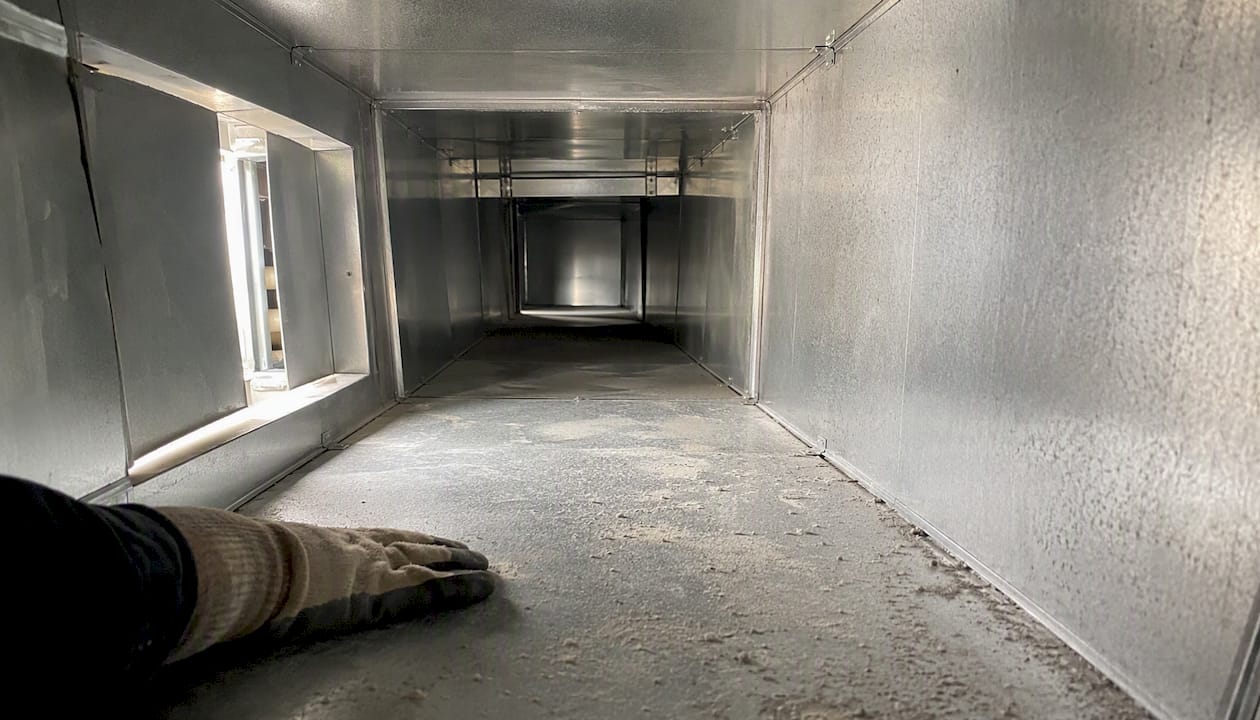
Labour hours for commercial jobs commonly run several hours to multiple days of crew time depending on scale, which is why labour is the single largest cost component in most project totals.
A typical commercial crew will arrive with negative-air machines, HEPA vacuums, rotary brushes, inspection cameras, and the tools to cut and seal access panels where needed. Expect some noise from the vacuuming equipment. Containment barriers are standard practice for occupied spaces. The crew should walk you through the system before starting and show you camera footage of problem areas before and after cleaning.
What a well-run commercial duct cleaning job looks like: The crew lead does a pre-job walkthrough with the building manager, confirms the scope in writing, and identifies any conditions that could change the price before work begins. Camera footage is captured at the start. Containment is set up in occupied areas. The job ends with a written completion report, before/after photos, and a signed confirmation of scope. Anything less than that is a shortcut you will pay for later.
A few practical scheduling notes: waste and removed filters are typically the contractor's responsibility to dispose of, but confirm this in writing. If access panels need to be cut into ductwork, the contractor should patch and seal them as part of the scope. After-hours work is common in healthcare, food service, and retail environments where daytime shutdowns are not feasible. Budget for that premium if your building falls into one of those categories.
Contaminants in HVAC systems also increase energy use, so a well-documented cleaning job gives you a baseline for tracking energy performance improvements after service.
Why certified local specialists reduce your procurement risk
The difference between a certified commercial duct cleaning specialist and a general contractor who offers duct cleaning as an add-on service is not subtle. Certification through the INCV (Institut des Nettoyeurs de Conduits de Ventilation) means the technician has been trained to industry standards specific to ventilation cleaning, not just general HVAC maintenance.
When evaluating any commercial duct cleaning provider, request the following before signing anything:
- Proof of liability insurance covering commercial work at your property
- WSIB compliance documentation (or the Québec equivalent for CNESST coverage)
- INCV certification for the technicians assigned to your job
- Before/after camera photos as a standard deliverable, not an optional add-on
- A written scope of work with itemized pricing before work begins
- References from comparable commercial clients in your region
Certification and documented evidence matter beyond quality assurance. For operations and insurance compliance, having a written record of who cleaned your system, what was found, and what was done protects you in the event of an air quality complaint, a fire code inspection, or an insurance claim. A contractor who cannot produce those documents is a liability, not a cost saving.
Get an on-site commercial duct cleaning estimate from Clean Vents
Clean Vents serves commercial properties across Laval and the surrounding Montréal area, with INCV-certified technicians and flat-rate transparent pricing. The services relevant to commercial clients include air duct cleaning, kitchen exhaust and coil cleaning, and dryer vent cleaning, all available as standalone services or bundled into a recurring maintenance agreement.
Every commercial job starts with an on-site estimate that includes a camera inspection and a written, itemized quote before any work begins. There are no surprise change orders for scope that was visible at the time of the estimate. Recurring contracts and bundled service packages are available for property managers who want predictable annual costs and lower per-visit rates.
Request your on-site commercial estimate and get a written quote with camera inspection included.
Sources
- Duct Cleaning Cost in Canada in 2026 - HomeStars
- Duct Cleaning Price Guide 2026: Average Rates & How to Charge
- Commercial Duct Cleaning Cost – Current Cost
- Publications
FAQ
How much does commercial duct cleaning cost in Canada?
Most commercial duct cleaning jobs in Canada fall between $1,500 and $6,000, with smaller office suites starting around a few hundred to around one thousand five hundred dollars and larger or more complex facilities running higher. Hourly rates typically sit at typical hourly rates around mid-range prices, and per-square-foot pricing ranges from $0.15 to $0.50 depending on building type.
How often should commercial air ducts be cleaned?
General offices typically need cleaning every 3–5 years, retail spaces every 2–4 years, and healthcare facilities every 1–2 years. Restaurant kitchen exhaust systems follow NFPA 96 schedules and may require cleaning every 3–12 months depending on cooking volume.
What time of year is best for commercial duct cleaning?
Late spring or early fall tends to work well because HVAC systems are between their peak heating and cooling seasons, making shutdowns less disruptive. The more practical consideration is your building's operating schedule: any window where the system can be taken offline during low-occupancy hours is a good time to book.
What are typical commercial duct cleaning rates in Canada?
Hourly crew rates run around typical hourly rates at mid-range prices, per-square-foot pricing falls between $0.15 and $0.50, and per-zone or per-system pricing typically ranges from several hundred dollars per unit. Final project totals depend heavily on building size, contamination level, and whether extras like mould remediation or kitchen grease degreasing are required.
Does Clean Vents provide written quotes for commercial jobs?
Yes. Every commercial estimate from Clean Vents includes an on-site walkthrough, a camera inspection, and a written itemized quote before any work begins. Bundled service packages and recurring maintenance contracts are available for property managers looking to reduce per-visit costs.